Selecting the right things to bring on a road trip for fun requires engineering the passenger cabin around three physical constraints that ruin multi-day highway drives: vestibular-visual sensory mismatch from looking down at screens (30–60° neck flexion during 0.1–0.4 Hz vehicle oscillations), multi-hour cellular dead zones across National Parks and rural interstates that cut off streaming media within 30 to 90 seconds, and 65–72 dBA highway tire rumble that drives unsealed headphone volume past safe listening limits. Skipping these cabin preparation steps leaves passengers vulnerable to rapid car sickness, dead-battery navigation failure inside zero-bar canyons, and unsafe 88–95+ dBA ear-canal volume spikes, whereas packing eyes-up audiobooks and road trip games, pre-caching offline audio and maps with verified DRM tokens, routing 30–65 W USB-PD power cleanly, and staging analog rest-stop challenges every 120 to 150 minutes keep kids, teens, and adult riders engaged without inducing nausea or distracting the driver.
While our family road trip checklist for kids and toddlers establishes child car-seat stages, reachable care bags, and hot-car safety rules, and our emergency kit and cabin setup guide separates survival reserves from daily cabin pouches, this passenger-focused guide details the human-factors ergonomics, offline storage math, acoustic thresholds, and eyes-up game mechanics that prevent motion sickness in car passengers across long highway corridors.
| Cabin Subsystem / Packing Item | Physiological or Technical Baseline | Road-Trip Target Specification (“Go”) | Dominant Failure Mode to Avoid |
|---|---|---|---|
| Passenger Gaze & Seating Geometry | CDC Yellow Book; ISO 2631-1 (0.1–0.4 Hz heave/sway); AAP |
0° distant horizon gaze; front passenger seat (13+ yr, 40–60% less kinetosis) or 2nd-row center (< 13 yr) |
30–60° head-down reading/scrolling in 2nd-row outboard or 3rd-row seats behind rear axle |
| Cabin HVAC & Postural Damping | CDC & AAP Motion Sickness | 64–68 °F (18–20 °C) fresh outside air directed at face; occiput rested against seat headrest |
Warm recirculated cabin air; unsupported flexing head adding Coriolis cross-coupled acceleration |
| Offline Audio & Map Pre-Cache | MB/h ≈ Bitrate (kbps) × 0.45; Official NPS App |
64 kbps HE-AAC audiobooks (~28.8 MB/h); 128–160 kbps podcasts (57.6–72 MB/h); 150–600 MB NPS/map packs |
Streaming buffers failing in 30–90 s inside 2–6 hr dead zones; expired 30-day DRM tokens on cold launch |
| Cabin 12V Power & Audio Split | USB-PD 3.0 / PPS (30–65 W); NHTSA pedal clearance |
Dual USB-C PD (30W+30W or 45W+20W) + 3.5 mm TRRS Y-splitter or BT 5.2/5.3 dual-stream to rear |
Legacy 5V / 1.0A (5 W) dash USB-A net drain under 8–15 W GNSS load; cords near driver pedals |
| Headphone Isolation & Volume Cap | WHO Safe Listening (H.870) & NIOSH |
Closed-back over-ear or ANC (15–25 dB attenuation); output locked ≤ 75 dBA (child) / ≤ 80 dBA (adult) |
Unsealed earbuds boosted +15 to +20 dB (88–95+ dBA) over 65–72 dBA highway tire rumble |
| Eyes-Up Cabin Game Deck | CDC Distracted Driving (0° passenger gaze, driver focus) |
License Plate Bingo, Alphabet Sign Race, 20 Questions, or < 5 s front-seat “Caller” trivia prompts |
Multi-piece lap board games or rear-seat card reading that force downward neck flexion |
Rest-Stop Challenge Kit (120–150 min) |
AAA (2 hr / 100 mi) & AAP (2 hr child break) |
35 mm ISO 400 27-exp film camera (2 frames/stop, stored < 75–80 °F), NPS Passport log, 8×42 binoculars, 5-min walk |
Using 8× binoculars in a moving car (8× vibration nausea); storing film in > 100–120 °F trunk |
1. How to Prevent Motion Sickness in Car Passengers: Vestibular-Visual Physics and Seating Hierarchy
Most road-trip boredom bags fail within the first thirty minutes of curvy highway driving because they pack head-down visual tasks—paperback books, coloring pads, comic books, and handheld video games. To prevent motion sickness in car passengers, every activity brought into the cabin must respect how the human brain integrates spatial motion.
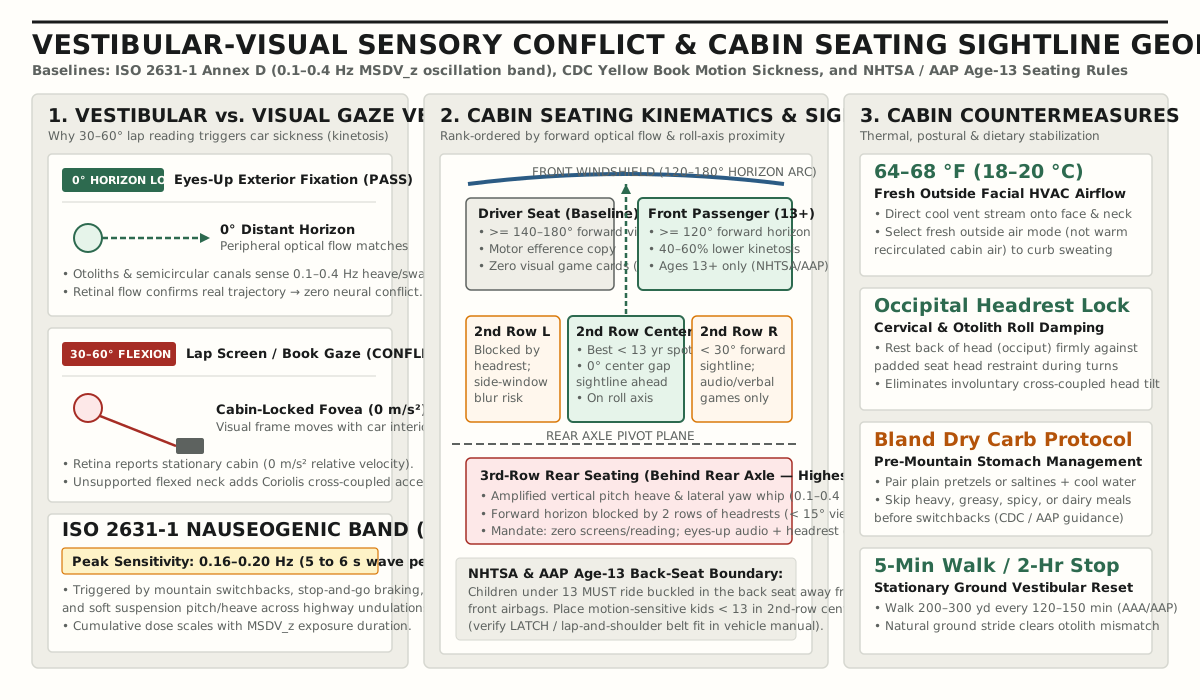
The Neural Mismatch Mechanism: ISO 2631-1 (0.1–0.4 Hz) vs. 30–60° Neck Flexion
According to the CDC Yellow Book on Motion Sickness and vestibular physiology research, car sickness (kinetosis) occurs when the central nervous system receives conflicting spatial orientation signals from three sensory channels:
- The Inner Ear Vestibular Labyrinth: Three orthogonal semicircular canals sense angular head velocity (pitch, roll, and yaw), while the otolith organs (the utricle and saccule) sense linear acceleration and gravitational tilt.
- The Visual System: Foveal fixation and peripheral retinal optical flow track how the external environment moves relative to the head.
- Somatosensory Proprioceptors: Mechanoreceptors in the cervical spine, back muscles, and seat cushions sense contact pressure and body sway.
When a passenger flexes the cervical spine downward at 30° to 60° to read a book, scroll a smartphone, or watch a lap-held tablet, the fovea and peripheral retina lock onto the vehicle interior. Because the cabin frame moves rigidly with the passenger, the visual channel reports 0 m/s² of relative velocity. At the exact same moment, the utricle, saccule, and semicircular canals register continuous lateral, longitudinal, and vertical accelerations from highway lane changes, braking, and road undulations—compounded by Coriolis-like cross-coupled angular accelerations whenever an unsupported, flexed head bobs during a turn.
Under ISO 2631-1 (Mechanical vibration and shock — Evaluation of human exposure to whole-body vibration, Annex D: Motion sickness dose value MSDV_z), human susceptibility to kinetosis is tightly concentrated in the ultra-low-frequency oscillation band between 0.1 and 0.5 Hz, reaching peak nauseogenic sensitivity at 0.16 to 0.20 Hz (a 5- to 6-second wave period) and spanning 0.1 to 0.4 Hz during mountain switchbacks, stop-and-go traffic, and soft-suspension highway heave. As MSDV_z exposure accumulates over 15 to 45 minutes of head-down reading in that 0.1–0.4 Hz window, the brainstem triggers stomach dysrhythmia, pallor, cold facial sweating, headache, and emesis.
Cabin Seating Sightline Hierarchy and the Age-13 Safety Boundary
Where a passenger sits determines both the amplitude of 0.1–0.4 Hz pitch/yaw motion they experience and how much forward horizon optical flow reaches their retina. Rank-order cabin seating using the following kinematic hierarchy while strictly enforcing American Academy of Pediatrics (AAP) and NHTSA child passenger safety rules:
| Cabin Seating Position | Unobstructed Forward Horizon Sightline | Kinematic & Vestibular Exposure Profile | Age / Restraint Boundary & Activity Rule |
|---|---|---|---|
| Driver Seat (Reference Baseline) | ≥ 140–180° full windshield optical flow |
Near 0% motion-sickness incidence: anticipates steering and braking via motor efference copy and tilts head into turns aligned with gravito-inertial force. |
Licensed drivers only. Per CDC Distracted Driving guidance, zero visual game cards, text reading, or device handling while driving. |
Front Passenger Seat (Optimal 13+ Spot) |
≥ 120° wide forward horizon optical flow through main windshield |
Reduces motion sickness by 40% to 60% vs. rear rows. Positioned near the vehicle’s longitudinal pitch and roll center of gravity with full peripheral horizon synchronization. |
Adults and teens age 13+ only. Per NHTSA and AAP rules, children under 13 must ride buckled in the back seat away from front passenger airbags. |
Second-Row Center Seat (Optimal < 13 Child Spot) |
Direct 0° azimuth central sightline between front seatbacks to the distant horizon |
Sits directly on the vehicle’s longitudinal roll axis (minimizing lateral roll displacement on curves) and ahead of the rear axle pivot plane. | Best motion-sickness seat for children under 13 riding in a forward-facing harnessed seat, booster, or lap-and-shoulder belt (verify anchor/belt fit in vehicle manual). |
| Second-Row Outboard Seats | < 30° forward view (blocked by front headrests and B-pillars); high-velocity lateral window blur |
Moderate pitch heave; looking sideways at passing guardrails or trees induces rapid optokinetic nystagmus without forward trajectory cues. | Keep gaze forward past the inboard shoulder of the front seat; replace all reading with eyes-up verbal games or offline audio. |
| Third-Row Rear Seats (Highest Risk) | < 15° forward tunnel view blocked by two rows of headrests and C-pillars |
Highest motion-sickness risk: located behind the rear axle, acting as a lever arm that amplifies vertical pitch heave and lateral yaw whip in the 0.1–0.4 Hz band. |
Zero screens, books, or downward glances. Use closed-back/ANC headphones, rest head firmly against headrest, and rotate susceptible passengers forward at stops. |
Cabin Microclimate (64–68 °F), Occipital Headrest Lock, and Dietary Pairing
Pair optimal seating with four physical cabin adjustments before entering curvy or hilly terrain:
- Direct Cool, Fresh Facial HVAC Airflow (
64–68 °F/18–20 °C): Set the climate control to fresh outside air intake (rather than warm, stale recirculated air whenever exterior air quality permits) and aim a cool vent stream directly onto the susceptible passenger’s face and neck. Cool facial airflow provides a steady trigeminal nerve thermal reference and suppresses early autonomic vasodilation and sweating. - Occipital Headrest Stabilization: Instruct passengers to press the back of the head (the occiput) firmly against the padded seat head restraint during turns and switchbacks. Immobilizing the head relative to the seatback eliminates involuntary cervical bobbing and cross-coupled semicircular canal stimulation.
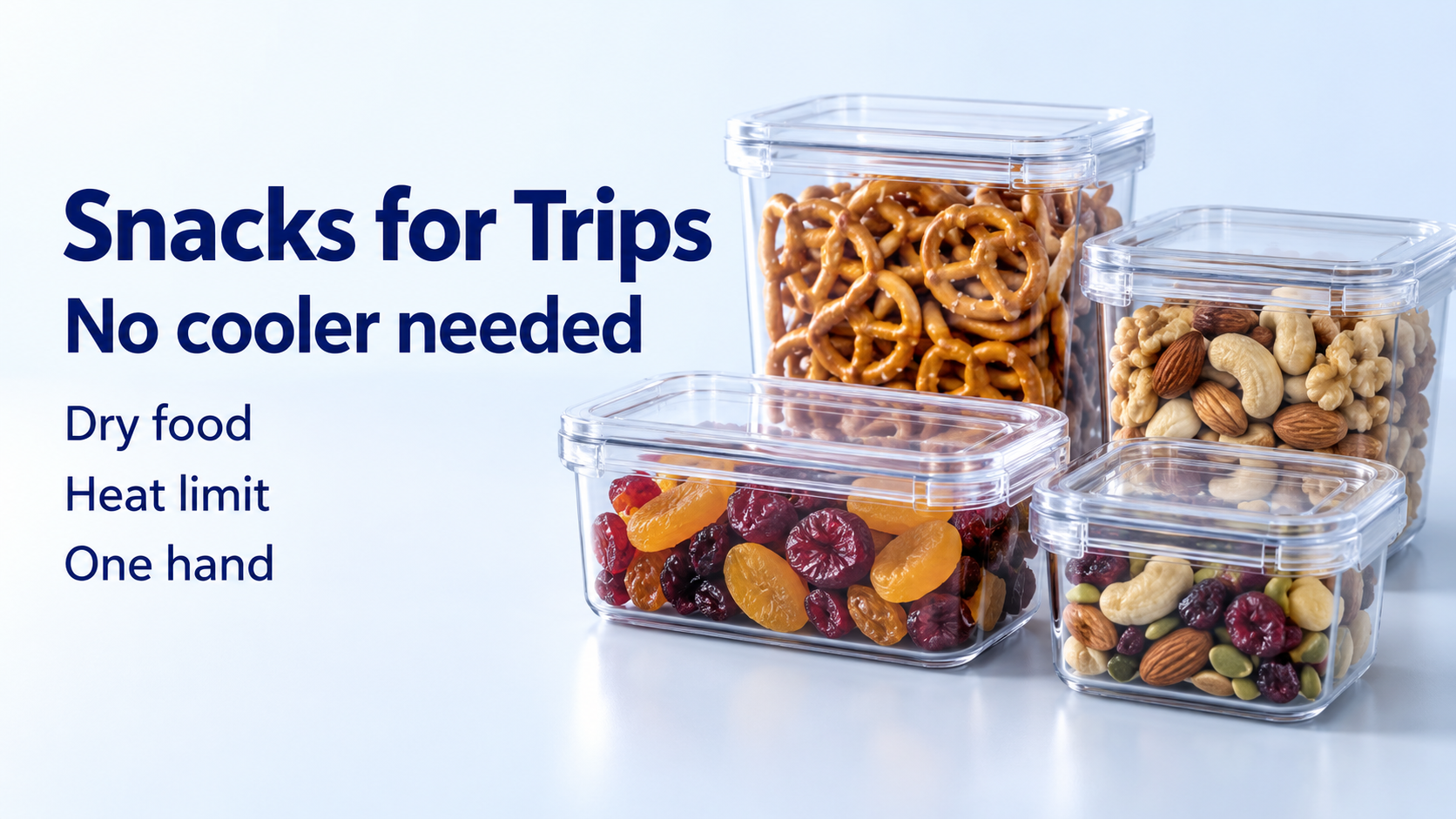
- Bland Dry Carbohydrates Over Greasy Meals: Following AAP motion-sickness guidance and the CDC Yellow Book, avoid heavy, greasy, spicy, acidic, or dairy-heavy fast food before driving mountain grades. Keep a rigid one-hand container of plain pretzels or saltine crackers from your no-cooler, non-messy road trip snack kit alongside cool water within passenger reach.
- Prophylactic Antihistamine Timing Window: Per the CDC Yellow Book, first-generation oral antihistamines (such as dimenhydrinate or meclizine) are effective only when taken
30 to 60 minutesbefore travel begins; once nausea and gastric stasis set in, oral absorption drops sharply. Because first-generation antihistamines cross the blood-brain barrier and cause significant drowsiness, they must never be taken by the active or relief driver, and pediatric dosing follows age-specific AAP and package boundaries.
2. Zero-Signal Dead-Zone Engineering: Offline Audiobooks, Bitrate Math, and Cabin Audio/Power Routing
Across major U.S. scenic routes—including Yellowstone, Yosemite, Zion, Grand Canyon, and Glacier National Parks, Bureau of Land Management (BLM) desert basins, and rural Interstate mountain passes—cellular data drops to zero for 2 to 6 hours at a stretch. Because live streaming apps buffer only 30 to 90 seconds of audio ahead of the playhead, a road-trip entertainment plan that relies on cellular data will go silent minutes past the canyon entrance.
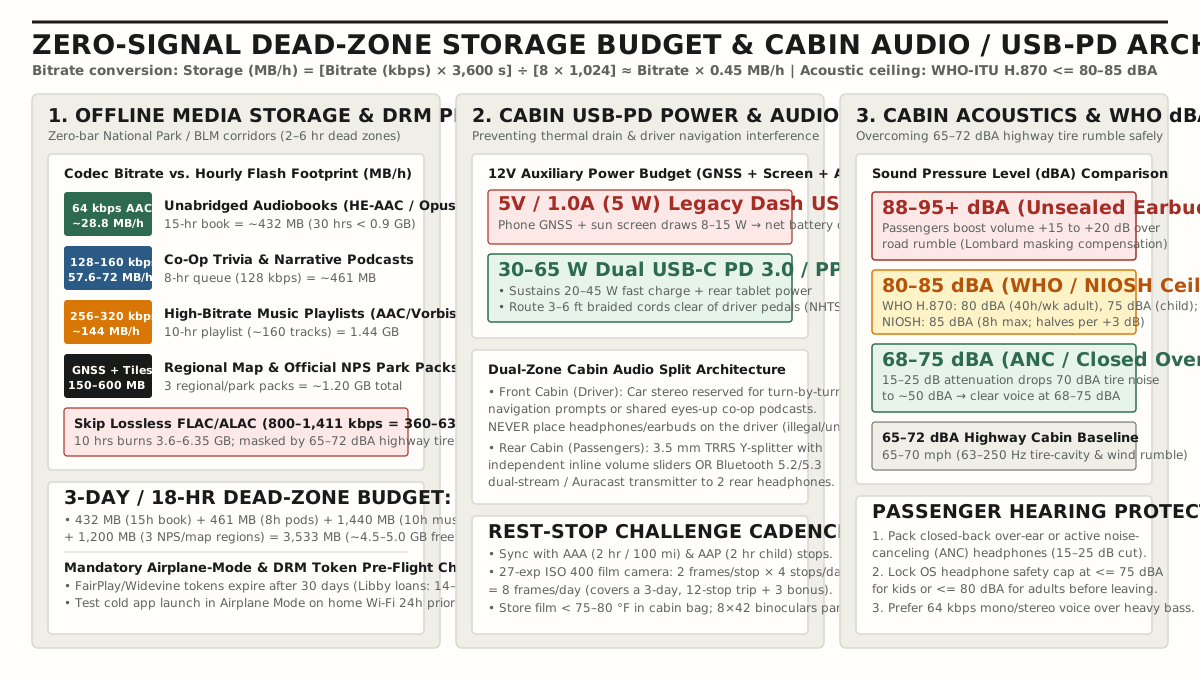
Offline Audio Bitrate-to-Storage Conversion Formula and Format Matrix
To size device flash storage accurately before departure, convert audio stream bitrates (kbps, kilobits per second) into hourly file footprints (MB/hour):
- Binary Megabyte (
MiB/hour) Formula:Storage (MiB/h) = [Bitrate (kbps) × 3,600 seconds/hour] ÷ [8 bits/byte × 1,024 KiB/MiB] = Bitrate (kbps) × 0.43945 MiB/hour - Decimal Megabyte (
MB/hour) Planning Rule:Storage (MB/h) ≈ Bitrate (kbps) × 0.45 MB/hour
Use this codec matrix to allocate flash storage across spoken-word audiobooks, co-op podcasts, music playlists, and Official NPS App offline park packages:
| Offline Media Category | Standard Codec & Bitrate | Hourly Storage Footprint (MB/h) |
Multi-Day Road Trip Storage Allocation |
|---|---|---|---|
Unabridged Voice Audiobooks (Audible, Libby, Apple Books) |
32–64 kbps mono/stereo HE-AAC or Opus (64 kbps high-voice standard) |
~14.4 to 28.8 MB/hour (~28.1 MiB/h at 64 kbps) |
One 15-hour unabridged novel at 64 kbps = ~432 MB (0.43 GB); 30 hours of family audiobooks = ~864 MB (< 0.9 GB). |
Narrative & Co-Op Trivia Podcasts (Spotify, Apple Podcasts, Pocket Casts) |
128–160 kbps stereo AAC or MP3 (voice + stereo music beds) |
~57.6 to 72.0 MB/hour |
8 hours of trivia and mystery episodes at 128 kbps = ~461 MB; 10 hours at 160 kbps = ~720 MB. |
High-Bitrate Offline Music Playlists (Spotify Very High, Apple Music AAC) |
256–320 kbps Ogg Vorbis or AAC |
~115.2 to 144.0 MB/hour |
10 hours of 320 kbps music (~150–180 tracks) = 1,440 MB (1.44 GB). |
Lossless / Hi-Res Audio Downloads (FLAC / Apple ALAC 16-bit/44.1 kHz+) |
800–1,411 kbps lossless FLAC or ALAC |
~360 to 635 MB/hour |
10 hours consumes 3.60 to 6.35 GB. Down-convert road-trip downloads to 160–320 kbps AAC/Vorbis to save 75% storage; 65–72 dBA road rumble masks lossless dynamic range. |
Offline Vector Maps & NPS Park Packs (Google Maps, Apple Maps, NPS App) |
Vector road/topographic tiles + NPS audio tours & visitor-center POIs | 150 to 600 MB per region or park pack |
3 regional/park packs at ~400 MB each = ~1,200 MB (1.20 GB). Smartphone L1/L5 GNSS chips track satellites with zero cell service once base tiles are cached. |
Worked Calculation Example 1: 3-Day, 18-Hour National Park Dead-Zone Storage Budget
Suppose two passengers are preparing a single smartphone or tablet for a 3-day, 18-hour driving loop through National Park and BLM dead zones. Applying Storage (MB/h) = Bitrate (kbps) × 0.45:
- Primary Family Audiobook (
15 hoursat64 kbps HE-AAC):15 h × (64 × 0.45 MB/h) = 15 h × 28.8 MB/h = 432 MB. - Co-Op Trivia & Mystery Podcast Queue (
8 hoursat128 kbps AAC):8 h × (128 × 0.45 MB/h) = 8 h × 57.6 MB/h = 460.8 MB(~461 MB). - Offline Music Playlists (
10 hoursat320 kbps):10 h × (320 × 0.45 MB/h) = 10 h × 144.0 MB/h = 1,440 MB(1.44 GB). - Offline Navigation & Official NPS App Packs (
3 regions/parksat400 MBaverage):3 × 400 MB = 1,200 MB(1.20 GB).
- Total Media & Map Pre-Cache:
432 + 461 + 1,440 + 1,200 = 3,533 MB(~3.53 GB). - Required Free Device Flash Storage: Including a mandatory
1.0 GBoperating-system swap and temporary cache buffer so the device does not purge offline app containers under low-storage pressure, clear at least4.5 to 5.0 GBof free storage before downloading.
The 30-Day DRM Token Trap and Mandatory Airplane-Mode Verification
Downloading files is only half of the dead-zone protocol. Subscription audio and library apps (Spotify, Apple Music, Audible Plus, and Libby public-library loans) wrap local audio files in FairPlay or Widevine Digital Rights Management (DRM) licenses:
- DRM Handshake & Loan Expirations: Offline subscription tokens typically require an online license renewal handshake every
30 days, while public-libraryLibbyaudiobook loans expire automatically after14 or 21 days. Furthermore, several apps fail to render their home screen if launched cold with zero cellular bars. - 24-Hour Pre-Flight Airplane-Mode Test: Complete all Wi-Fi downloads at least
12 to 24 hoursbefore departure (part of Stage 2 in our car prep and packing checklist). Then switch the phone or tablet into Airplane Mode with both Wi-Fi and cellular data disabled, force-close each audio and map application, relaunch them cold, and verify that every audiobook, podcast episode, and NPS offline map plays and pans without requesting a network login.
Cabin 30–65 W USB-PD Power Budget, Audio Splitters, and WHO Safe Listening (≤ 80 dBA)
Keeping offline audio running for 6 to 8 hours per driving day requires matching the cabin’s electrical supply and acoustic isolation to highway conditions:
- 12V
USB-PD 3.0Power Budget (30–65 W) vs. Legacy5 WPorts: A smartphone running continuousL1/L5 GNSSsatellite positioning, a sunlit dashboard screen, and Bluetooth audio draws8 to 15 Wcontinuously. Legacy factoryUSB-Adashboard ports rated at5V / 1.0A(5 W) or5V / 1.5A(7.5 W) cannot keep up, resulting in net battery drain and thermal throttling. Pack a 12V auxiliary socket charger supportingUSB-C Power Delivery (USB-PD 3.0 / PPS)rated at30 W to 65 Wacross dual ports (30W + 30Wor45W + 20W). Confirm your vehicle’s 12V battery (12.60–12.80 VrestingOCV) and alternator (13.8–14.5 Vloaded) are healthy using our tires, fluids, brakes, and 12V battery checklist, and route3- to 6-footbraided charging cables completely clear of the steering column, gear selector, and driver footwell pedals in accordance with NHTSA floor-mat and pedal clearance guidance. - Multi-Listener Audio Splitting & Driver Ear Isolation: When rear-seat passengers listen to a separate audiobook or kids’ podcast while the driver needs clear navigation prompts, pack either a passive
3.5 mm TRRSY-splitter cable with independent inline volume sliders or a Bluetooth5.2/5.3dual-stream transmitter (LE Audio / Auracast) paired to two rear headphones. Never allow the driver to wear headphones or earbuds—doing so is illegal in multiple U.S. jurisdictions and masks emergency sirens, horns, and tire-tread acoustic warnings. - Highway Cabin Noise (
65–72 dBA) vs.WHOSafe Listening Limits: At65 to 70 mph(105–113 km/h) on coarse asphalt or concrete pavement, passenger-car interior noise measures65 to 72 dBA, dominated by63–250 Hzlow-frequency tire-cavity resonance and wind rumble. Passengers wearing open or unsealed earbuds automatically raise volume by+15 to +20 dBabove the noise floor (the Lombard masking effect), driving ear-canal sound pressure levels to88 to 95+ dBA. Under World Health Organization (WHO-ITU H.870) safe listening standards, the permissible weekly listening ceiling is80 dBAfor up to 40 hours/week for adults and75 dBAfor children, while occupationalNIOSHstandards set an85 dBA8-hour ceiling (where safe exposure time halves for every+3 dBincrease above85 dBA). Equipping passengers with closed-back over-ear headphones or Active Noise-Canceling (ANC) headphones (15–25 dBlow-frequency attenuation) drops perceived cabin rumble to~50 dBA, allowing clear spoken-word comprehension at a safe68 to 75 dBAwith OS headphone safety limiters locked on.
3. Eyes-Up Road Trip Games and Co-Op Cabin Activities (0° Horizon Fixation)
The best audiobooks and road trip games replace downward lap reading with 0° exterior horizon scanning or pure auditory problem-solving. Every game in the matrix below keeps rear passengers looking out the windows at distant targets moving congruently with the vehicle’s trajectory—whilst respecting the CDC distracted driving rule that the driver’s eyes stay on traffic and hands remain on the wheel.
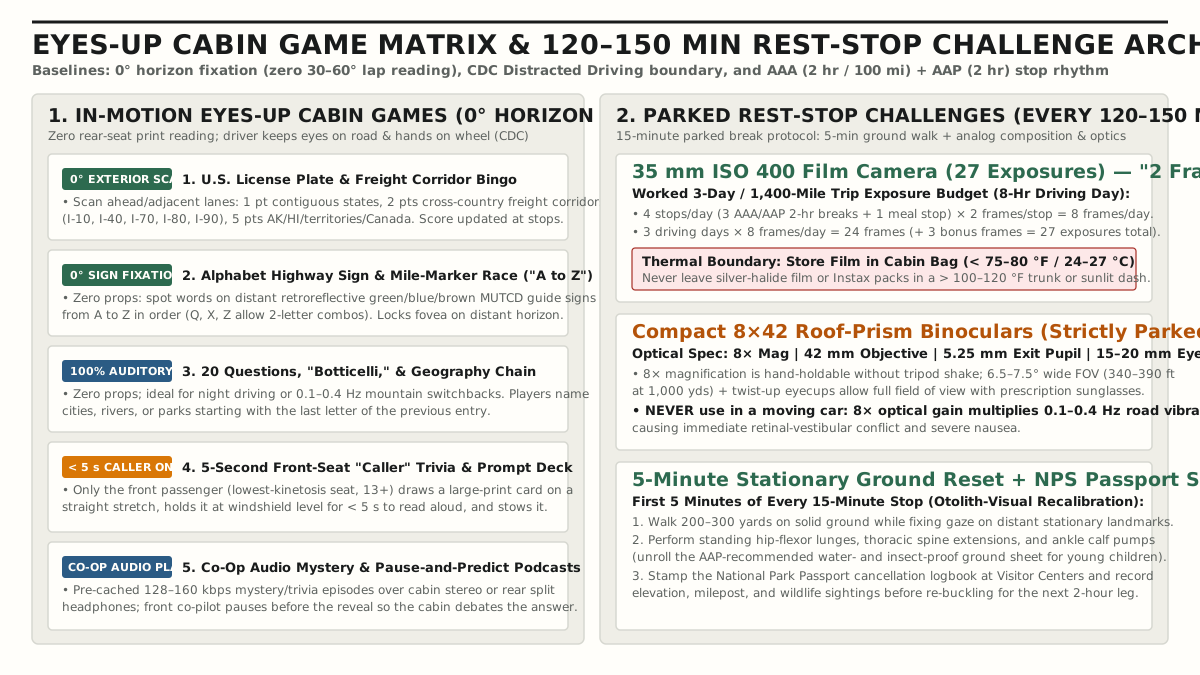
| Eyes-Up Game / Cabin Activity | Passenger Gaze Vector & Sensory Channel | Cabin Props Required | Highway Gameplay Mechanics & Motion-Sickness Safeguard |
|---|---|---|---|
| 1. U.S. State License Plate & Freight Corridor Bingo | 0° forward and shallow-angle horizon scanning + verbal callouts |
1 magnetic or dry-erase U.S. map board (held by a single non-sensitive scorekeeper or updated only at rest stops) | Players scan ahead and adjacent lanes for out-of-state plates: 1 pt for contiguous states, 2 pts for cross-country plates along freight corridors (I-10, I-40, I-70, I-80, I-90), and 5 pts for Alaska, Hawaii, U.S. territories, or Canadian provinces. Zero prolonged 45° lap reading. |
| 2. Alphabet Highway Sign Race (“A to Z”) | 0° forward horizon fixation on distant retroreflective MUTCD guide signs |
Zero props (100% exterior visual + verbal) |
Players spot words on green/blue/brown highway exit boards, mile markers, and commercial trailers starting with each letter from A to Z in strict sequence (Q, X, and Z permit two-letter combinations or plate characters). Locks fovea on distant horizon objects. |
| 3. 20 Questions, “Botticelli,” & Geography Chain | 100% auditory / verbal (0° horizon gaze or eyes closed against headrest) |
Zero props | Ideal for night driving, mountain switchbacks (0.1–0.4 Hz sway), or early stomach awareness. In Geography Chain, each player names a city, river, national park, or country starting with the last letter of the prior answer (Denver → Yellowstone → Eugene → El Paso). |
| 4. 5-Second “Caller” Trivia & Prompt Deck | < 5-second eye-level glance by front passenger (“Caller”); 0° gaze for rear rows |
1 compact box of large-print trivia or conversation cards stored in the glovebox | Only the front passenger (riding in the lowest-kinetosis seat) draws a card on a straight highway stretch, holds it up near windshield level for < 5 seconds to read the question aloud, and sets it down. Rear passengers never read print. |
| 5. Co-Op Audio Mystery & Pause-and-Predict Podcasts | 100% auditory over cabin stereo or split rear headphones (0° horizon gaze) |
Pre-cached offline trivia/mystery podcast queue or full-cast dramatized audiobook | Play episodic history mysteries, lateral-thinking puzzles, or family trivia over the cabin speakers; the front-seat co-pilot hits pause before the solution reveal so passengers debate the verdict aloud. |
4. 120–150 Minute Rest-Stop Challenges: Analog Film, Optics, and the 5-Minute Vestibular Reset
Even the best cabin setup cannot override human physiology indefinitely. Our daily driving distance and fatigue guide and family road trip checklist establish the non-negotiable stop cadence: AAA recommends a driver alertness break every 2 hours or 100 miles, and the American Academy of Pediatrics recommends stopping about every 2 hours (2 to 3 hours by day for infants) so children can stretch out of their seats. Turning each 120- to 150-minute (100- to 130-mile) rest stop into a structured 15-minute passenger challenge breaks up highway monotony and flushes accumulated vestibular mismatch.
Tangible Rest-Stop Challenge Kit: Specifications and Thermal/Optical Boundaries
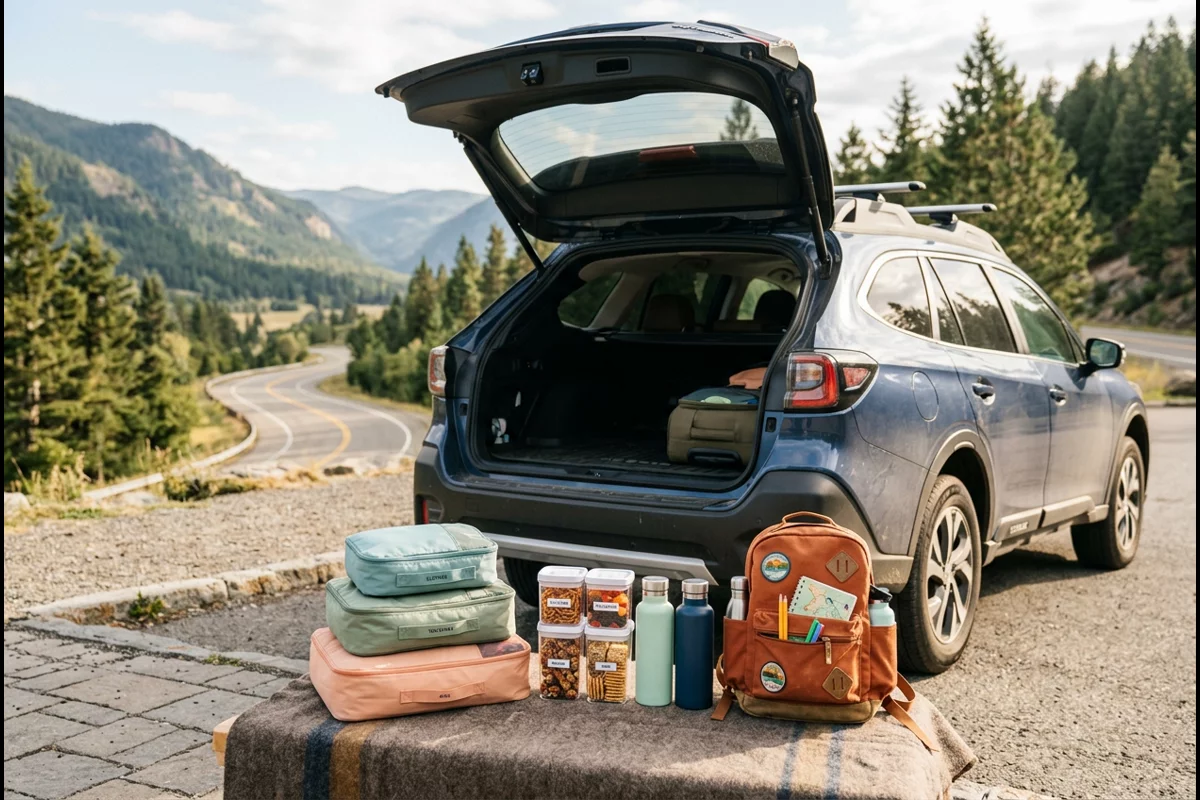
Pack a dedicated rest-stop pouch inside the air-conditioned cabin (separate from the roadside emergency kit) containing four items used exclusively while the vehicle is safely parked:
- Disposable
35 mmFilm Camera (ISO 400,27 Exposures) or Instant Print Camera (Fujifilm Instax):- Technical Specification: Choose
ISO 400color negative film (27 exposures) for versatile exposure across bright midday overlooks and shaded forest pullouts, or an instant print camera with a twin-pack (20 sheets). - Thermal Storage Boundary (
< 75–80 °F): Store film cameras and spare cartridges inside the air-conditioned cabin bag (< 75–80 °F/24–27 °C) and take the bag indoors at overnight stops. Never store photographic film or instant print packs inside a trunk, roof box, or sunlit glovebox where temperatures exceed100 to 120 °F(38–49 °C)—heat fogs silver-halide emulsion layers, shifts color balance, and dries out instant chemical developer pods.
- Technical Specification: Choose
- National Park Passport Cancellation Stamp Logbook & Field Sketch Pad:
- Rest-Stop Protocol: Pair a spiral-bound Passport cancellation booklet with a waterproof pigment-ink pen. At National Park Visitor Centers, Ranger Stations, and state historic markers, passengers step out to stamp the dated location cancellation mark and sketch or log the elevation, temperature, and milepost.
- Compact
8×42Roof-Prism Binoculars:- Optical Specification: Pack
8×magnification with42 mmobjective lenses (8×42), which yields a bright5.25 mmexit pupil (42 mm ÷ 8 = 5.25 mm) for dawn and dusk wildlife spotting, a wide6.5° to 7.5°field of view (340 to 390 feet at 1,000 yards), and15 to 20 mmof eye relief with twist-up eyecups so passengers wearing prescription eyeglasses or polarized sunglasses see the full circular field. - Parked-Use Only Rule: Never look through
8×binoculars inside a moving car. An8×optical system multiplies0.1–0.4 Hzvehicle pitch and vibration eightfold across the retina without matching inner-ear acceleration, triggering severe vestibular nausea in seconds.
- Optical Specification: Pack
- The 5-Minute Dynamic Vestibular & Postural Reset Routine:
- Execution at Every Stop: Spend the first
5 minutesof every15-minutebreak walking200 to 300 yardson solid pavement or a trail while fixing gaze on distant stationary landmarks, followed by standing hip-flexor lunges, thoracic spine extensions, and ankle calf pumps (for toddlers and young kids, unroll the AAP-suggested water- and insect-proof ground sheet). Active walking on stationary ground generates natural, self-propelled optic flow and proprioceptive feedback that rapidly recalibrates the inner ear’s otolith-visual integration before the next2-hourdriving leg.
- Execution at Every Stop: Spend the first
Worked Calculation Example 2: Rest-Stop Cadence & 27-Exposure Film Budget
To see how a single analog camera structures an entire multi-day itinerary without screen scrolling:
- Consider an 8-hour driving day covering
480 milesat a60 mphnet moving average, paced to the AAA and AAP2-hour / 100-milestop interval. - The schedule produces 3 en-route rest breaks plus 1 meal/scenic stop =
4 stops per driving day. - Under a strict “2 Frames Per Stop” challenge (1 wide landscape or landmark composition + 1 candid passenger portrait while parked), the group exposes
4 stops/day × 2 frames/stop = 8 exposures per driving day. - Across a 3-day, 1,400-mile road trip (
12 total stops), the crew uses12 stops × 2 frames = 24 exposures, leaving exactly3 bonus frameson a standard 27-exposureISO 400roll for the final destination arrival—producing a curated physical photo series with zero in-motion screen time.
5. Pre-Departure Passenger Fun & Comfort Packing Checklist
Work through this passenger cabin checklist alongside our complete 3-stage car prep and packing checklist so offline downloads, power routing, and seating assignments are locked in before departure morning.
24 Hours Before Departure (Home Wi-Fi & Flash Storage Gate)
- Device Storage Buffer (
4.5–5.0 GBFree): Clear at least4.5 to 5.0 GBof local flash storage on the primary cabin phone or tablet (~3.5 GBmedia/maps +1.0 GBOS buffer). - Offline Audio Queue Downloaded: Download
15–30 hoursof unabridged family audiobooks (64 kbps HE-AAC/Opus,~28.8 MB/h),8–10 hoursof co-op trivia and narrative podcasts (128–160 kbps,57.6–72 MB/h), and backup music playlists (160–320 kbps; skip800–1,411 kbpslossless files). - Offline Maps & Official NPS App Cached: Download regional vector map bounding boxes in Google/Apple Maps plus full offline park packages in the Official NPS App (
150–600 MBper park). - DRM Token & Airplane-Mode Cold Test: Verify
Libbylibrary loans (14–21 daywindow) and subscriptionDRMtokens (30-daywindow) will not expire mid-trip; switch the device to Airplane Mode, force-close every app, relaunch cold, and confirm playback and map rendering with zero network connection. - OS Headphone Volume Limiters Locked: Enable
Headphone Safety/ volume caps at≤ 75 dBAfor children and≤ 80 dBAfor adults (WHO safe listening baseline).
Cabin Setup Before Pulling Out (Seating, Power & Acoustics)
- Motion-Sickness Seating Assigned: Seat the most motion-sensitive adult or teen (
13+) in the front passenger seat (≥ 120°forward horizon view); seat the most motion-sensitive child under age 13 in the second-row center seat (0°central sightline between front seats, buckled in their age-appropriate car seat, booster, or belt per our family road trip checklist). - 12V
USB-PDPower & Cable Routing: Plug a30–65 Wdual-portUSB-C PD 3.0adapter into the 12V socket (after verifying 12V battery and alternator health via our vehicle mechanical checklist) and route3–6 ftbraided cables clear of the driver’s footwell pedals and shifter (cabin setup and emergency kit guide). - Closed-Back /
ANCHeadphones & Splitter: Place closed-back over-ear orANCheadphones (15–25 dBroad-noise isolation) and a3.5 mm TRRSY-splitter orBluetooth 5.2/5.3dual-stream transmitter in the rear passenger pouches; keep the driver completely ear-free. - HVAC, Bland Snacks & Prophylaxis: Set cabin HVAC to
64–68 °F(18–20 °C) fresh outside air aimed toward susceptible passengers; stage one-hand containers of plain pretzels/crackers and cool water (no-cooler road trip snacks guide); if a passenger uses an approved oral motion-sickness antihistamine, dose30–60 minutesprior to departure (never used by the driver). - Glovebox “Caller” Deck & Cabin Film Storage: Put the 5-second trivia card deck in the front passenger door pocket or glovebox, and store the
35 mm ISO 400film camera (< 75–80 °F), NPS Passport booklet, and8×42binoculars in a shaded cabin pouch.
Every 120 to 150 Minutes En Route (2-Hour / 100-Mile Stop Rhythm)
- Eyes-Up Cabin Rule: Keep all moving-car play strictly at
0°horizon gaze (License Plate Bingo, Alphabet Sign Race, 20 Questions, or front-seat Caller prompts); halt any screen or print reading immediately at the first sign of yawning, stomach awareness, or pallor. - 5-Minute Ground Reset + 2-Frame Photo Challenge: Stop every
2 hours or 100 miles(long-drive daily distance guide); walk200–300 yardson stationary ground fixing gaze on distant landmarks, expose2 frameson the27-exposurecamera, stamp the NPS logbook, and use the8×42binoculars while parked. Explore more trip preparation guides in Road Trips.