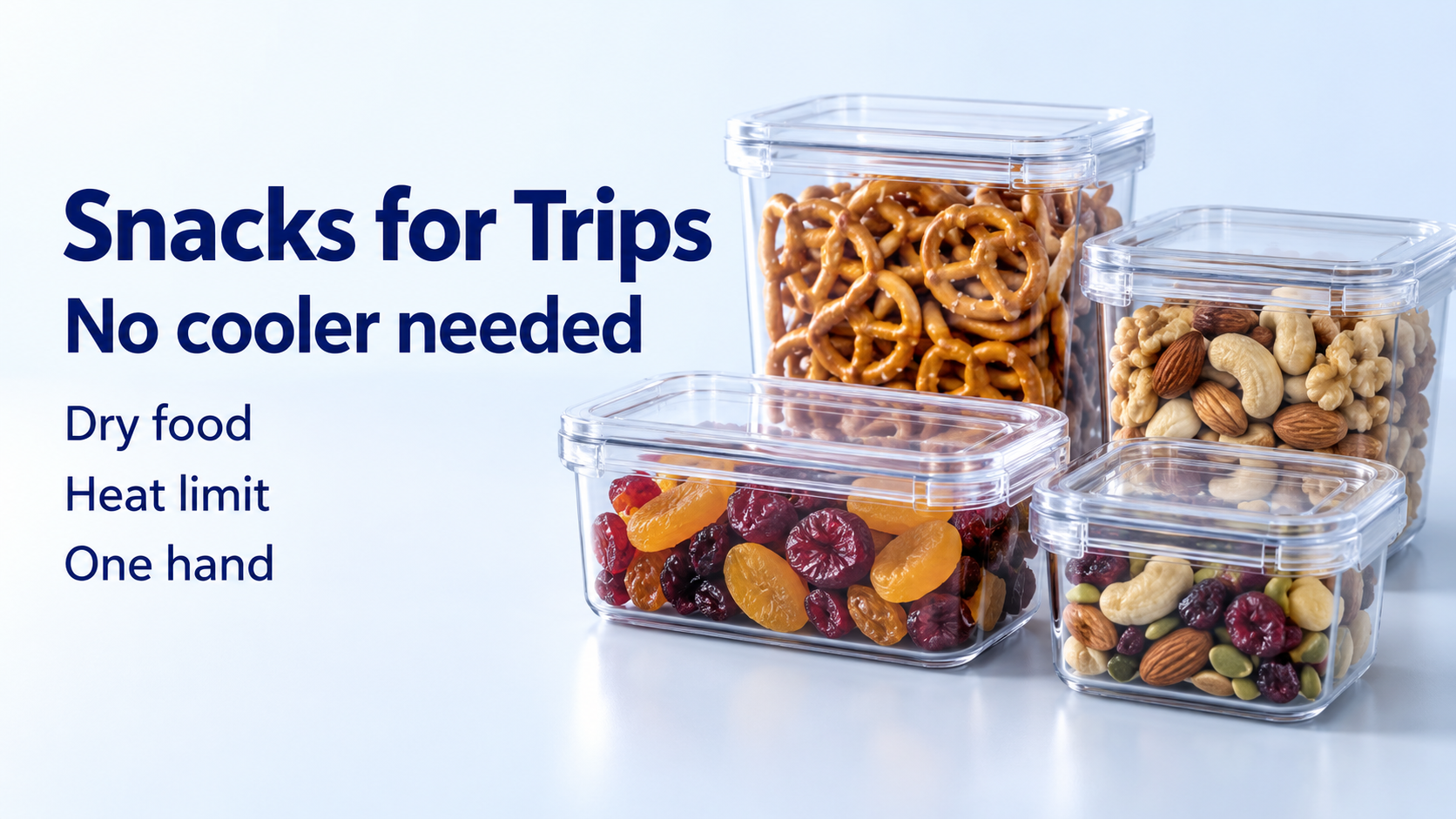
The wrong snacks for road trips can waste food and leave melted coatings or crumbs in the seats. For a no-cooler, non-messy bag that handles warmth better, choose shelf-stable, uncoated foods such as shelled nuts, dried fruit, plain pretzels and label-approved jerky, then portion them before departure.
The easiest snacks for road trips need no refrigeration under their package directions, leave little residue and fit in a container a passenger can manage with a hand free. Start with dry, uncoated choices; keep whole fruit separate from crushable food and reserve anything that needs spreading, utensils or careful peeling for a stop. Here, heat-tolerant means choosing away from melting coatings and fragile textures, while following the food’s storage instructions. The one-hand suggestions are for adult passengers or parked breaks: the CDC identifies eating while driving as a distraction.
| Input or item | Typical value or source | Why it matters |
|---|---|---|
| No-cooler eligibility | Package permits room-temperature storage; USDA, Shelf-Stable Food Safety, opening definition | A sealed package can still require refrigeration |
| Dry snack base | Nuts, trail mix and jerky appear in USDA’s Keep Cold Foods Cold section | They offer alternatives to a cooler-dependent snack bag; check each label |
| Handling | Pre-portion, choose shelled foods and avoid loose coatings; editorial packing advice | Reduces crumbs, shells and sticky hands |
| Heat exposure | USDA recommends cool, dry storage for shelf-stable products | Shelf-stable does not mean suitable for indefinite storage in a parked car |
| Perishable-food limit | Refrigerate within 2 hours, or within 1 hour above 90°F; FoodSafety.gov, Chill, accessed October 19, 2026 | The no-cooler plan needs a firm exclusion boundary |
Which no-cooler snacks make the least mess?
Choose shelled nuts and plain pretzels for dry handling, and small portions of dried fruit or shelf-stable jerky for variety. The comparison below ranks practical handling tradeoffs, rather than nutritional value or a tested heat rating.
USDA’s outdoor food-safety guide, under Keep Cold Foods Cold, lists nuts, trail mix, whole fresh produce, jerky, and peanut butter and jelly among foods that need no cooler. Its shelf-stable guidance makes the storage label decisive. Our suggestions below add containment and cleanup choices to that storage boundary.
| Snack option | Best use in the bag | Warmth and handling tradeoff | Dominant Failure Mode & Prevention |
|---|---|---|---|
| Shelled nuts or seeds, without sticky coatings | Adult passenger’s dry snack container | Loose pieces spill; allergy suitability depends on the travelers | Spillage or shell waste → choose shelled food and a container with a secure lid |
| Dried fruit without an added coating | A separate small container | Pieces may clump or feel sticky; choose a texture you already like | Sticky pieces spread residue → avoid a shared open bag and close the lid between uses |
| Plain pretzels or firm crackers | Dry snack, protected from luggage | Crumbling remains possible even without a melting coating | Crushing creates crumbs → use a rigid container and avoid powder-heavy varieties |
| Uncoated shelf-stable bar | Wrapped option for a parked break | Texture varies; a crumbly bar may suit a picnic better than a seat | Crumbs or softened topping → choose an uncoated product and open it over its wrapper |
| Commercial jerky labeled for unrefrigerated storage | Savory option, if its label fits the trip | Some meat snacks require refrigeration; opening can change storage needs | Assuming all jerky travels alike → read storage directions before and after opening |
| Whole apple or easy-peel citrus | Parked break or passenger snack | Cores and peels need a waste bag; protect fruit from bruising | Leaking damaged fruit or peel litter → keep fruit separate and collect waste immediately |
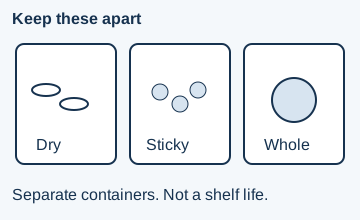
Skip chocolate-coated trail mix for this particular bag. Choose plain crackers over heavily powdered ones when upholstery cleanup matters. Nut butter is a useful shelf-stable food when its label permits, but spreading it is a parked-stop task; a jar and knife do not meet the one-hand brief.
These are adult handling suggestions. For children, adapt food form and eating arrangements to their age and needs rather than copying the adult snack list.
What does heat-tolerant actually mean?
It means the snack is less prone to becoming a melted mess; it does not establish a safe hot-car storage period. USDA defines shelf-stable food by room-temperature storage and recommends keeping it cool and dry, away from temperature extremes (Shelf-Stable Food Safety, opening definition and Will commercially canned foods last forever?, accessed October 19, 2026).
Keep the snack bag out of direct sunlight and bring it indoors when you unload for the night. That is an editorial packing choice that follows the source’s storage principle. A shaded bag still is not refrigeration. If a package specifies a storage temperature, that instruction governs; this guide cannot supply an alternative temperature or shelf life for an unknown product.
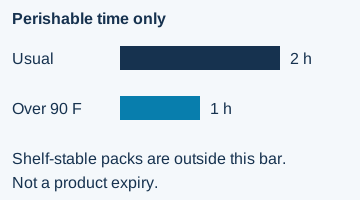
Threshold rule: If perishable food is exposed to temperatures above 90°F, refrigerate it within 1 hour; the usual limit out of refrigeration is 2 hours. With no cold source available, keep that food out of the planned snack bag. These limits apply to perishables, not as an expiry timer for unopened shelf-stable snacks. Source: FoodSafety.gov, Chill, accessed October 19, 2026.
The numerical effect of that rule can be written explicitly:
Hot-weather allowance fraction = above-90°F time limit ÷ usual unrefrigerated time limit.
Editorial calculation from those two published limits: 1 hour ÷ 2 hours = 0.5. FoodSafety.gov prints the 1-hour and 2-hour limits, not this ratio. It applies only to perishable food under the conditions above.
This calculation explains why a perishable snack can become the weak point in a warm car. It does not calculate how long nuts, bars or jerky will last.
How do you pack snacks for one-hand access?
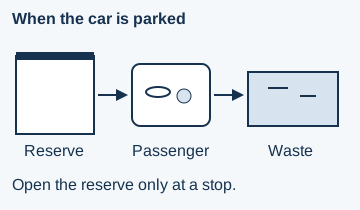
Portion food while parked, then give passengers a closed container that can sit securely between bites. Keep the reserve bag closed so that opening a snack does not expose everything else.
- Put crushable food in a rigid container and dried fruit in its own compartment or bag.
- Leave individually wrapped food wrapped until the eating stop; retain labels when repacking food with storage or allergy instructions.
- Separate whole fruit from containers that could bruise it. FoodSafety.gov’s cleaning guidance says to rinse produce under running water before peeling or cutting.
- Keep a waste bag and napkins with the food, where a passenger can use them without asking the driver to reach behind a seat.
- Open awkward packaging and deal with spills at a safe parked stop.
The CDC’s driver and passenger guidance says drivers should avoid multitasking and passengers can help with other tasks. A snack that is easy to hold still takes attention to eat; one-hand access is a convenience feature for passengers and parked breaks.
Where is the waste and rework boundary?
Pack food you can store correctly and finish without creating leftovers that need refrigeration. Bringing a bulk package may reduce individual wrappers, but repeatedly opening it also creates more chances to spill, crush food or lose its label. Reusable containers are worthwhile when you can clean and dry them between uses.
For each option, count the practical costs: wrappers to collect, containers to wash, crumbs to remove and food that might need discarding. The lowest purchase price is not automatically the least wasteful choice. Buy around the next realistic replenishment stop rather than filling the car with food you may not use.
If perishable food exceeds the time limit above, discard it rather than trying to rescue it for a later stop; cooling it later does not erase the earlier storage history. USDA’s outdoor guide also directs travelers to chill leftovers promptly or discard them when they cannot keep them cold. Unopened shelf-stable food can return to appropriate indoor storage if its label and package condition permit.
Use the car preparation and packing checklist to put food, drinking water and cleanup supplies into the wider departure plan. That is the boundary between a snack list and a workable car setup: food should not force the driver to search luggage or improvise a stop because supplies were buried.
Methods and sources
The food-storage boundaries come from USDA FSIS and FoodSafety.gov guidance retrieved on October 19, 2026; the driver-attention boundary comes from the CDC. The snack comparison and packing arrangements are editorial applications of those sources. Individual package directions determine eligibility, and product-specific heat limits and shelf lives remain unspecified. The calculation uses only the published perishable-food time limits.
Article date: October 18, 2026. Browse the road trip and car lifestyle guides for the wider trip plan.