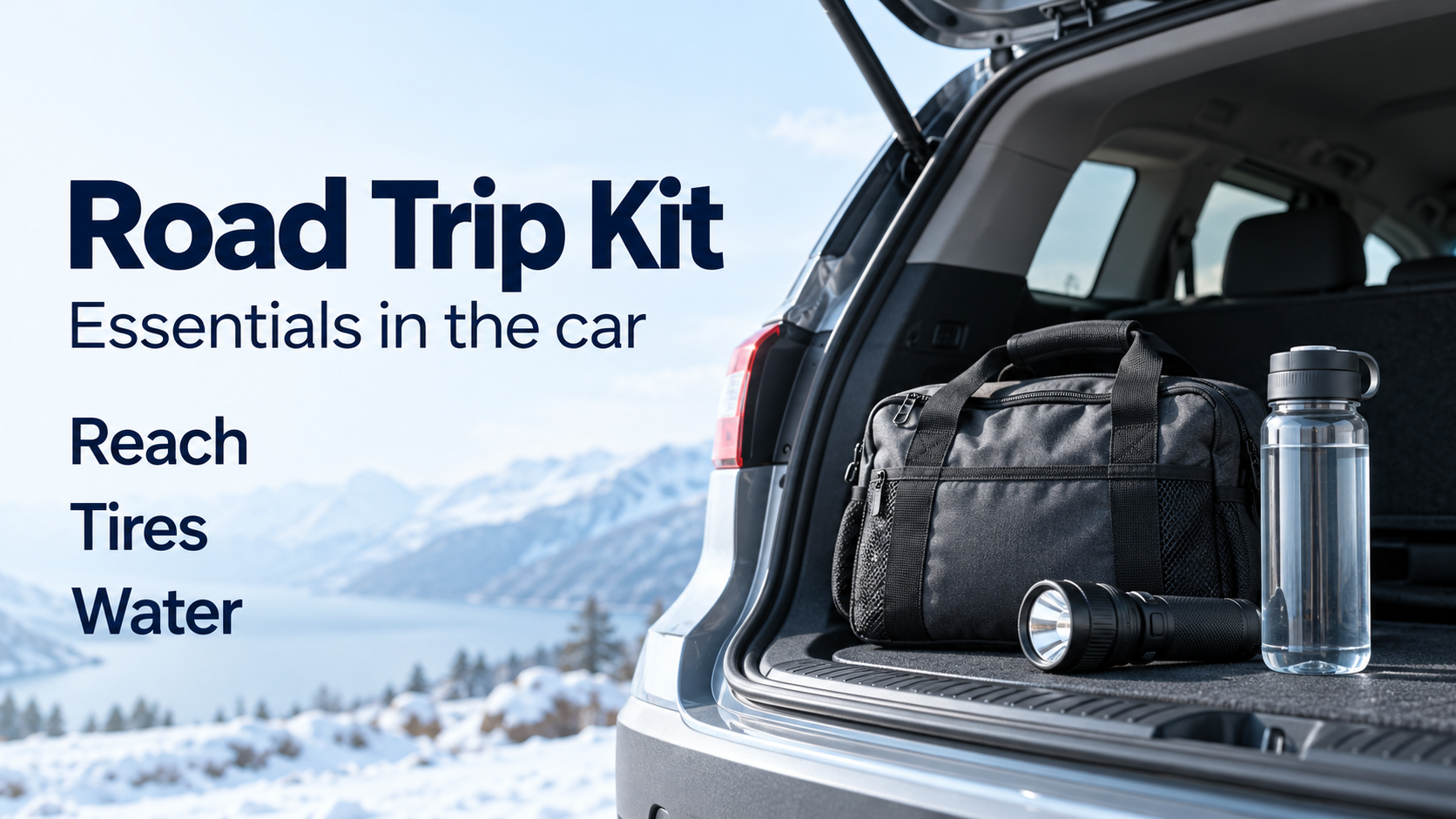
A flashlight buried under luggage or a charger that does not fit can waste time when you need help. Pack road trip essentials as a reachable emergency kit plus a restrained, uncluttered cabin setup, using the official kit lists as the starting inventory.
Road trip essentials begin with communication, first aid, visibility, vehicle-specific tire equipment, drinking water, nonperishable food, medicines and weather protection. Put emergency items in a known place you can access when safely parked, and keep daily passenger supplies separate so they do not consume the reserve. Set up charging, directions and storage before departure. NHTSA supplies the roadside-kit baseline; FEMA adds broader disaster-kit planning. The layouts below are editorial packing suggestions, and the vehicle manual governs equipment fit and storage.
| Input or item | Typical value or source | Why it matters |
|---|---|---|
| Roadside kit | NHTSA, Summer Driving Tips → Stock Your Vehicle | Covers breakdown-related communication, visibility and supplies |
| Cold tire-pressure check | At least 3 hours after driving; NHTSA, Tires, accessed October 19, 2026 | A recently driven tire is outside that cold-check condition |
| Inflation target | Vehicle door placard or owner’s manual; NHTSA, Tires | The tire sidewall maximum is not the vehicle’s recommended pressure |
| Emergency water baseline | 1 US gallon per person per day for several days, for drinking and sanitation; FEMA toolkit, printed page 8, accessed October 19, 2026 | A disaster-planning provision, rather than a personal drinking prescription |
| Floor mats | Correct fit and retention clips; NHTSA, Floor Mats | Mats must not interfere with the pedals |
| Device setup | Drivers avoid multitasking; CDC, What you can do | Set up before moving and let passengers handle other tasks |
What belongs in the emergency kit?
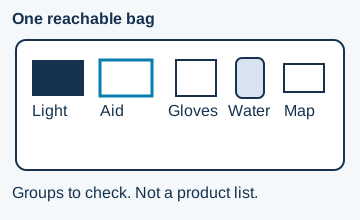
Use NHTSA’s list to inventory what the vehicle already carries before buying a prepacked kit. The following groups reproduce its main item categories; they are supplies to check, not instructions to perform a roadside repair.
| Group | Items to inventory | Packing decision |
|---|---|---|
| Communication and navigation | Phone, charger and maps | Confirm the cable fits and the charging arrangement works while parked |
| First aid and personal needs | First-aid kit, medicines | Check contents, expiry and storage instructions; include supplies appropriate to your training and needs |
| Light and visibility | Flashlight, flares and white flag | Keep light and warning supplies accessible; follow equipment instructions and local restrictions |
| Tire and battery equipment | Pressure gauge, jack with ground mat, jumper cables | Check the vehicle manual and supplied equipment before adding anything |
| Work and cleanup | Gloves, change of clothes, basic tools, duct tape, water and paper towels | Separate dirty equipment from food and medicines |
| Waiting supplies | Nonperishable food, drinking water, blankets, towels and coats | Adjust for the route, weather and travelers |
| Vehicle fluid | Extra windshield washer fluid | Follow the vehicle’s fluid and storage requirements |
Source: NHTSA, Stock Your Vehicle, accessed October 19, 2026. Its first-aid entry also includes a tourniquet; equipment inclusion should be paired with knowing its intended use.
The FEMA toolkit, printed pages 7–9, discusses a broader disaster supply kit, including backup phone power and supplies for individual needs. Use it to think through an extended disruption. Its household list is broader than the contents every car needs for an ordinary drive.
How should the cabin and cargo area be arranged?
Give frequently used passenger items a small, fixed place, and keep emergency equipment accessible separately from overnight luggage. Confirm the arrangement in the actual vehicle while parked and belted; an organizer that forces a reach across the driver is in the wrong place.
| Setup | When it helps | What to check | Dominant Failure Mode & Prevention |
|---|---|---|---|
| Closed cabin pouch or organizer | Passenger water, tissues, charging cable and directions | Secure storage; no interference with seat belts, controls or the vehicle’s specified airbag areas | Loose items or distracting searches → contain items and adjust the layout before driving |
| Dedicated emergency bag | Flashlight, first aid, warning supplies and gloves | Can it be retrieved while safely parked without emptying the luggage? | Buried supplies → pack the bag at an accessible opening and keep its access clear |
| Cargo reserve | Extra water, food and weather layers | Use the vehicle’s storage and load-restraint instructions | Luggage blocks the reserve → check access after the final bag goes in |
| Shared bag for every purpose | May seem convenient for a short outing | Repeatedly opening it can mix dirty tools, snacks and medicines | Missing or depleted kit items → separate daily-use contents from emergency supplies |
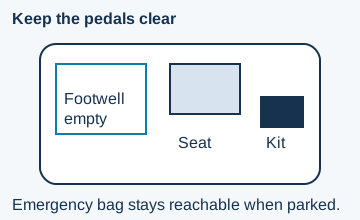
These placements are editorial suggestions rather than an official universal cabin layout. Keep charging leads and loose objects away from the driver’s footwell. NHTSA’s Floor Mats guidance specifically calls for correctly fitted, secured mats because interference with the pedals increases crash risk. Do the same practical clearance check after packing, without driving the car.
Set the destination and choose audio before leaving. The CDC, under What you can do, advises drivers against multitasking and says passengers can assist with navigation or other tasks. If a mount, cable or bag needs adjusting, deal with it when safely parked.
Which tire and power tools are actually compatible?
Compatibility comes from your vehicle’s manual and the equipment instructions. A generic list cannot determine the correct jack points, spare-tire arrangement, starting procedure or accessory-power connection for an unknown car.
Check what came with the vehicle, where it is stored and whether anything is missing. Carrying a jack does not make a traffic-exposed shoulder a suitable work area. When the location or procedure is unsafe or uncertain, request roadside assistance rather than attempting a repair.
Threshold rule: If fewer than 3 hours have passed since driving, the tire-pressure reading does not meet NHTSA’s stated cold-check condition. Arrange the cold check before departure and use the door placard or owner’s manual for the target. Source: NHTSA, Tires, accessed October 19, 2026. Do not delay help for a visibly damaged or dangerously underinflated tire while waiting for that condition.
A portable inflator and a jump starter are optional additions to evaluate against the vehicle and product manuals. Their required pressure capability, electrical compatibility, battery capacity and operating limits remain product-specific. A device that charges a phone is not automatically a vehicle jump starter. Charging, storage and temperature instructions also need checking before either device goes into a hot car.
How do you calculate a water reserve without guessing?
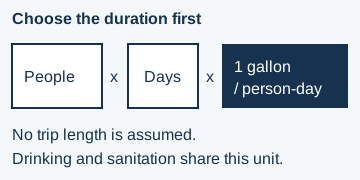
Start with the emergency-planning rate, then choose a reserve duration that fits the route and likely disruption. FEMA’s January 2025 toolkit, printed page 8, specifies 1 US gallon per person per day for several days, for drinking and sanitation; it does not specify an exact reserve duration for your road trip (accessed October 19, 2026).
Water reserve (US gallons) = travelers (people) × reserve duration (days) × 1 US gallon/(person·day).
Source-only unit example: 1 person × 1 day × 1 US gallon/(person·day) = 1 US gallon for a person-day, using FEMA’s published per-person daily provision (toolkit, printed page 8, accessed October 19, 2026).
The example expresses the daily unit in the source; it does not replace FEMA’s recommendation to plan for several days. Choose the actual duration before multiplying, account for your travelers’ needs and keep routine drinks separate from the reserve. Enter your actual traveler count and reserve duration to obtain a trip total.
Water also creates a packing problem: confirm that the selected containers fit secure storage and that the emergency bag remains accessible. If the load does not fit the vehicle’s limits or leaves essentials buried, revise the load and route plan before departure.
Where do buying, waste and repacking stop?
Stop adding gear when it duplicates working equipment, lacks confirmed compatibility or prevents access to essential supplies. Start with an inventory, then replace missing, expired, damaged or unsuitable items rather than buying a second complete kit by default.
| Hidden cost | Boundary before you pack |
|---|---|
| Duplicate equipment | Check the factory kit and existing household supplies before purchasing |
| Expired food or medical supplies | Follow labels and replace unsuitable items; keep routine snacks separate from reserves |
| Repacking work | Put in the overnight luggage, then test emergency-bag access while parked |
| Dead or incompatible equipment | Confirm operation, connectors and manual requirements before relying on it |
| Food waste and dirty tools | Separate food and personal supplies from repair and cleanup equipment |
The car preparation and packing checklist is the next boundary check: finish the vehicle inspection and resolve faults before judging the car ready from its packed equipment. A purchased kit cannot complete those checks. Use the packing section to catch missing documents and personal items, then confirm that the final load still leaves this kit accessible.
Methods and sources
This guide uses NHTSA’s roadside list and cold-tire condition, FEMA’s January 2025 toolkit for disaster provisions, and CDC guidance on driver distraction, retrieved on October 19, 2026. Placement suggestions and the inventory comparison are editorial applications of the guidance. The water example uses only the source’s per-person daily unit; it assumes no household size, trip duration or equipment performance.
Updated October 19, 2026. Browse the road trip and car lifestyle guides to continue planning.