An existing E-ZPass transponder already works statewide on Florida toll roads at electronic toll rates, whereas driving north from Florida into E-ZPass states requires a portable SunPass PRO rather than a permanent windshield-sticker SunPass Mini. Knowing that one-way hardware rule prevents surprise toll invoices and double charges on East Coast trips.
Electronic toll compatibility between Florida and the eastern states expanded in stages rather than overnight. On May 28, 2021, Florida’s Turnpike Enterprise announced that its SunPass facilities would begin accepting E-ZPass while E-ZPass facilities began accepting SunPass PRO transponders, excluding SunPass Mini and earlier SunPass Portable models (Wikipedia, SunPass). If you are driving a rental car rather than your own vehicle, review our separate Florida rental car tolls guide before choosing between a personal transponder and a rental-agency toll program.
Can You Use E-ZPass as a SunPass in Florida?
Yes: since 2021, the entire state of Florida has accepted E-ZPass on SunPass-equipped highways and express lanes, building on the Central Florida Expressway Authority’s 125-mile network that began accepting E-ZPass in 2018 (Wikipedia, E-ZPass). Drivers using a funded E-ZPass in Florida pay the electronic toll rate rather than higher plate-billing rates.
Central Florida Expressway Authority (CFX) customer guidance confirms that E-ZPass works on its 125-mile toll road network and across the entire state of Florida, billing transactions at the electronic toll rate. Avoiding camera-based plate billing matters because CFX states that Pay By Plate invoices are charged at double the electronic E-PASS rate starting July 1 when no valid toll account covers the license plate.
Two local boundaries still apply when driving in Florida with an out-of-state transponder:
- Independent toll bridges can sit outside the E-ZPass network even inside an E-ZPass state. In Florida, Gasparilla Bridge and Hammock Dunes Bridge are listed among independent facilities that do not accept E-ZPass.
- Central U.S. hub tags face agency-specific limits inside Florida. While Kansas, Oklahoma, and Texas transponders work on all roads operated by Florida’s Turnpike Enterprise, they cannot be used on tolled roads maintained by the Central Florida Expressway Authority.
Which States Cover SunPass Mini, SunPass PRO, and E-ZPass?
SunPass Mini is restricted to Florida, Georgia, Kansas, North Carolina, Oklahoma, and Texas, whereas SunPass PRO works in Florida plus 23 other states covering everywhere E-ZPass is accepted. E-ZPass spans agencies across 20 member states as of 2024 and expanded in September 2026 to the Central United States Interoperability Hub.
Florida’s Turnpike Enterprise states that both SunPass Mini and SunPass PRO work across Florida, Georgia, Kansas, North Carolina, Oklahoma, and Texas, and that SunPass Mini cannot be used outside those states. SunPass PRO adds every state where E-ZPass is accepted: Colorado (excluding Northwest Parkway), Delaware, Illinois, Indiana, Kentucky, Maine, Maryland, Massachusetts, parts of Michigan (Bay City), Minnesota, New Hampshire, New Jersey, New York, Ohio, Pennsylvania, Rhode Island, Virginia, and West Virginia.
| Transponder | Hardware and Mounting | Multi-State Coverage | Cross-Region Compatibility | Vehicle and Axle Limits |
|---|---|---|---|---|
| SunPass Mini | Credit-card-sized passive RFID sticker with no battery; adheres permanently to glass below the rearview mirror | Florida, Georgia, Kansas, North Carolina, Oklahoma, and Texas | Does not work on northern E-ZPass toll roads outside those states | Destroyed if removed; not for motorcycle use because motorcycle windshields are not glass |
| SunPass PRO | Portable transponder mounted below the rearview mirror and movable from car to car | Florida and 23 other states, including all six SunPass Mini states plus every E-ZPass state and Colorado E-470 | Accepted anywhere E-ZPass is accepted | Works on motorcycles; meant for two-axle vehicles (three or more axles outside Florida need NC Quick Pass) |
| E-ZPass | Active Type II RFID tag powered by a battery designed to last about 10 years; uses 3M Dual Lock strips, third-party suction trays, or front license-plate mounts | Member agencies in 20 states as of 2024, plus September 2026 Central U.S. Hub (Kansas Turnpike, Colorado E-470, Oklahoma turnpikes, certain Texas roads) | Accepted statewide across Florida toll roads at electronic rates | Programmed per vehicle class; mismatching vehicle class triggers wrong billing and a violation; Flex adds HOV switch in select states |
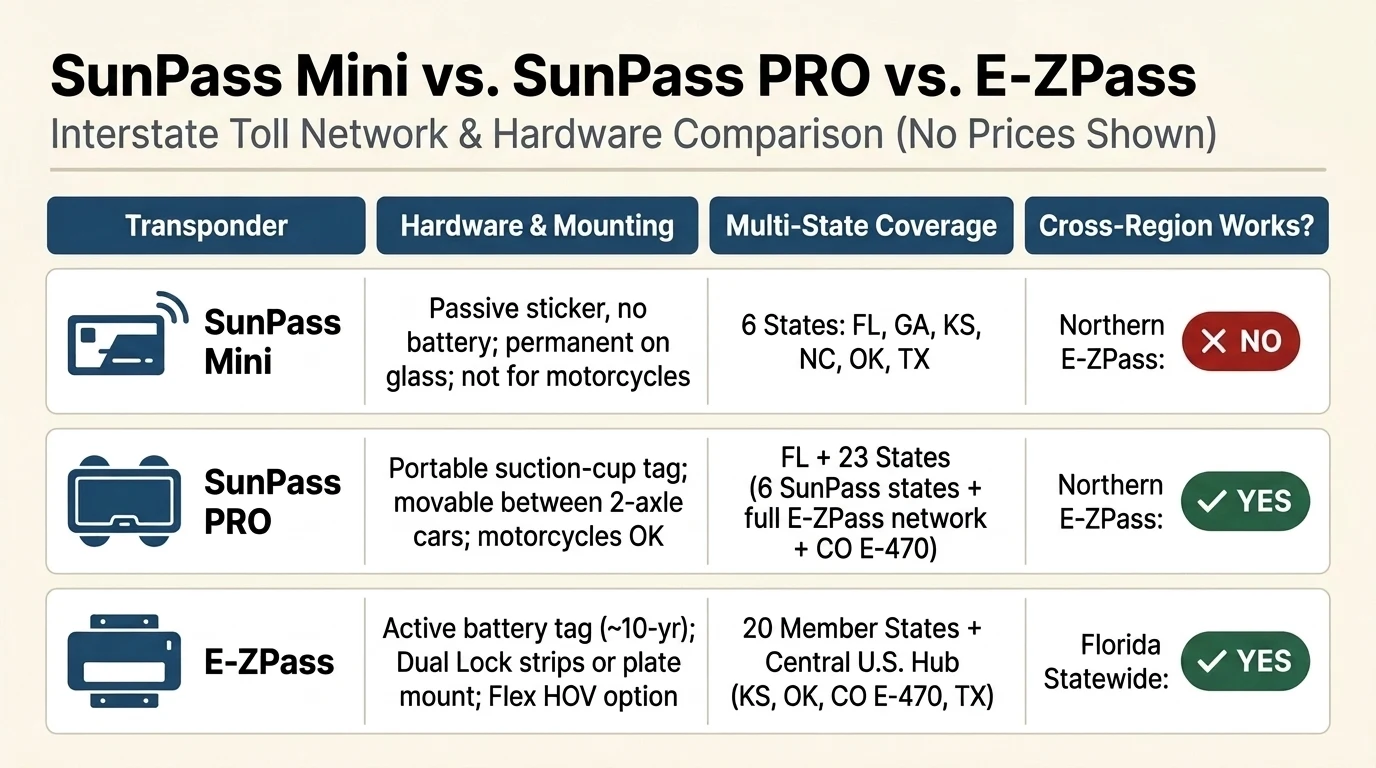
Interstate coverage and hardware differences across SunPass Mini, SunPass PRO, and E-ZPass based on Florida’s Turnpike Enterprise and E-ZPass Interagency Group interoperability records.
Recent multi-state agreements have narrowed the gap between southern, eastern, and central toll hubs, yet nationwide coverage is still incomplete. In March 2025, Florida’s Turnpike Enterprise reached an interoperability agreement with the Harris County Toll Road Authority making SunPass accepted statewide in Texas, followed in November 2025 by an agreement with the E-470 Public Highway Authority covering E-470 and Colorado’s express lanes network. In September 2026, E-ZPass similarly added compatibility with the Central United States Interoperability Hub covering the Kansas Turnpike, Colorado E-470, Oklahoma’s turnpike network, and certain Texas toll roads. Outside these eastern and central networks, western systems such as California’s FasTrak remain incompatible with E-ZPass.
Is SunPass or E-ZPass Better for Your Driving Pattern?
Choose SunPass if most of your toll miles are inside Florida, and choose E-ZPass if you regularly drive Northeast or Mid-Atlantic corridors where home-agency discounts or HOV switching apply. Reciprocity guarantees that a compatible tag will be read across state lines, not that out-of-state drivers receive local commuter discounts.
When Florida-Based Drivers Benefit From SunPass
Florida’s Turnpike Enterprise states that SunPass customers always pay the lowest toll amount in Florida and save an average of 25 percent on tolls compared to TOLL-BY-PLATE. Within Florida, SunPass is fully interoperable with E-PASS (Central Florida Expressway Authority), LeeWay (Lee County toll bridges), and Miami-Dade Expressway Authority toll roads.
SunPass also adds everyday conveniences tailored to Florida residents and frequent visitors:
- Wide retail access and cash loading: drivers can buy a transponder at thousands of Florida retail locations including Publix, CVS Pharmacy, and Walgreens, or add funds with cash at participating Florida stores without needing a credit card, debit card, or bank account.
- Airport and venue parking: Florida’s Turnpike Enterprise notes that SunPass works for parking at most major airports in Florida, Port Canaveral, and Hard Rock Stadium in Miami.
- Simple mail delivery: ordering through the SunPass Customer Service Center at 1-888-865-5352 ships a transponder within 4 to 5 business days.
When Northeast and Mid-Atlantic Drivers Should Keep E-ZPass
Within the E-ZPass Interagency Group, each member agency runs its own billing center and establishes its own tag deposit or nonrefundable purchase charge, periodic maintenance fees, paper statement fees, low-account thresholds, replenishment amounts, and discount plans (Wikipedia, E-ZPass). Three E-ZPass rules directly affect drivers who spend significant time north of Georgia:
- Agency-restricted discounts: reciprocity applies to tag acceptance, not to discounts. Eight Northeast authorities — Maine, the Massachusetts Turnpike, the New Hampshire Turnpike, Rhode Island, New York TBTA, the New York State Thruway, the New Jersey Turnpike, DelDOT, and Maryland — restrict their general discounts to their own respective tagholders.
- Residency flexibility and inactivity limits: E-ZPass users are not required to maintain an account with an agency in their home state and can open an account with any member of the Interagency Group regardless of residency. Check inactivity terms before choosing an issuer, because New Hampshire sends an inactivity warning at 18 months and automatically closes accounts after 24 months, while Virginia issues a warning at 12 months with 30 days to respond.
- Regional extras and urban surcharges: E-ZPass Flex transponders issued by Virginia, Maryland, Minnesota, and North Carolina let drivers switch between HOV and toll-paying modes on supported express lanes while working as a standard E-ZPass everywhere else. For credit-card-replenished accounts from participating Port Authority agencies, E-ZPass Plus also covers parking at John F. Kennedy, LaGuardia, and Newark Liberty airports. In Manhattan, New York City’s Congestion Relief Zone south of 60th Street began on January 5, 2025, and charges vehicles without E-ZPass transponders around 50 percent more.
| Driver Profile | Best Primary Tag | Why This Match Fits | Key Rule to Verify Before Driving |
|---|---|---|---|
| Florida resident staying inside Florida and southern partner states | SunPass Mini | Delivers Florida’s lowest toll rate and average 25 percent savings over TOLL-BY-PLATE without battery maintenance | Permanent glass mount only; cannot be removed intact or used in northern E-ZPass states |
| Florida resident or snowbird driving up the East Coast in a two-axle car | SunPass PRO | Keeps Florida’s lowest toll rates and airport parking while adding full E-ZPass state coverage and vehicle portability | Limited to two-axle vehicles outside Florida; local Northeast commuter discounts do not transfer |
| Northeast or Mid-Atlantic commuter visiting Florida | Home-agency E-ZPass | Keeps local agency toll discounts at home and works statewide across Florida toll roads at electronic rates | Check whether your route crosses independent Florida bridges such as Gasparilla Bridge or Hammock Dunes Bridge |
| Driver with an RV, trailer, or vehicle with three or more axles crossing state lines | Matching-class E-ZPass or NC Quick Pass | Avoids SunPass PRO’s two-axle limit outside Florida and matches E-ZPass vehicle-class programming | Confirm the transponder’s programmed vehicle class matches the vehicle before entering toll lanes |
How Do SunPass PRO and E-ZPass Hardware and Vehicle Rules Differ?
SunPass Mini is a batteryless passive sticker destroyed upon removal, SunPass PRO is a movable two-axle transponder usable on motorcycles, and E-ZPass is an active battery-powered RFID unit offering external license-plate mounts and multi-class vehicle programming. Hardware choice determines whether you can swap tags between cars or ride a motorcycle.
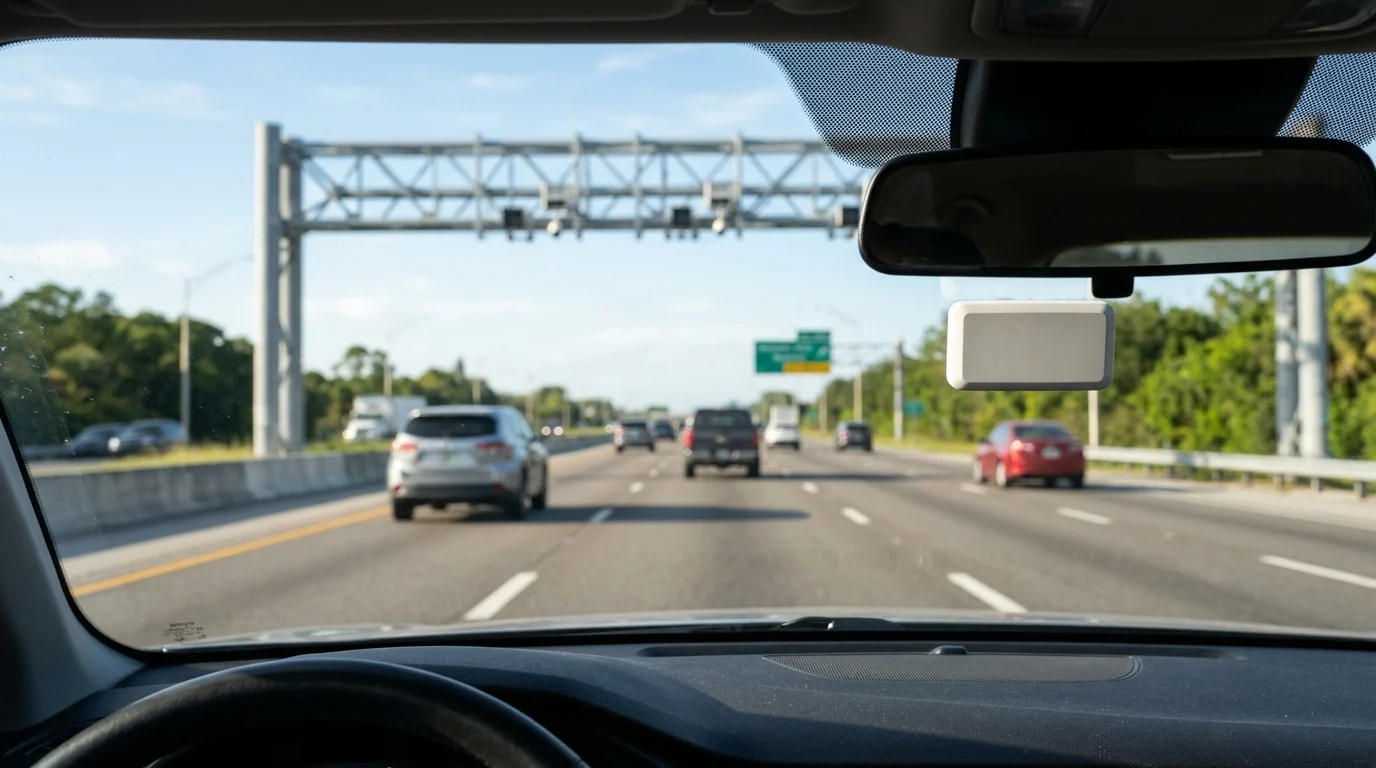
SunPass Mini uses passive RFID technology about the size of a credit card with no batteries, must adhere to the vehicle’s glass windshield just below the rearview mirror, and cannot be removed without destroying the pass. Because motorcycle windshields are not made of glass, SunPass Mini will not work on motorcycles, whereas Florida’s Turnpike Enterprise specifies that SunPass PRO is movable from car to car and can be used on motorcycles.
Standard internal E-ZPass transponders operate on active Type II read/write RFID over a 915 MHz signal at 500 kbit/s using the TDM (formerly IAG) protocol in 256-bit packets, powered by an internal battery designed to last about 10 years. Toll agencies advise mounting internal E-ZPass tags near the rearview mirror with adhesive mounting strips such as 3M Dual Lock fasteners, while third-party suction-cup trays allow temporary transfer between vehicles. For cars with windshields that block RF signals, historical vehicles, or aesthetic preferences, agencies offer an external E-ZPass tag that bolts to the front license-plate mounting points.
Two operational rules catch multi-vehicle and last-minute travelers off guard:
- Match vehicle class and axle count: each E-ZPass tag is programmed for a specific vehicle class, and placing a passenger-car tag in a higher-class vehicle leads to incorrect toll charges and a violation. On the SunPass side, SunPass PRO is meant for vehicles with two axles, and vehicles with three or more axles traveling outside Florida are required to purchase an NC Quick Pass instead.
- Allow time for reciprocity sync: E-ZPass member agencies exchange tag data nightly across the reciprocity network. Updates can take up to 24 hours on the primary network that issued the tag and may be delayed by as much as 72 hours on partner networks, so activate new tags and update license plates well before departure.
Do You Need Both SunPass and E-ZPass—and How Do You Prevent Double Charges?
Most two-axle drivers traveling between Florida and the Northeast do not need both transponders because one E-ZPass or one SunPass PRO works across both regions. Carrying both a Florida toll pass and an E-ZPass unshielded in the same car risks paying the same toll twice on interoperable roads.
The Central Florida Expressway Authority explicitly warns that traveling on CFX roads with both a Florida-based toll pass (E-PASS, SunPass, or LeeWay) and an E-ZPass can result in charges to both accounts. For motorists who own multiple transponders, CFX recommends removing the E-ZPass transponder from the vehicle or placing it inside a Radio Frequency (RF) shield bag while driving throughout Florida to prevent both transponders from being read at the same gantry.
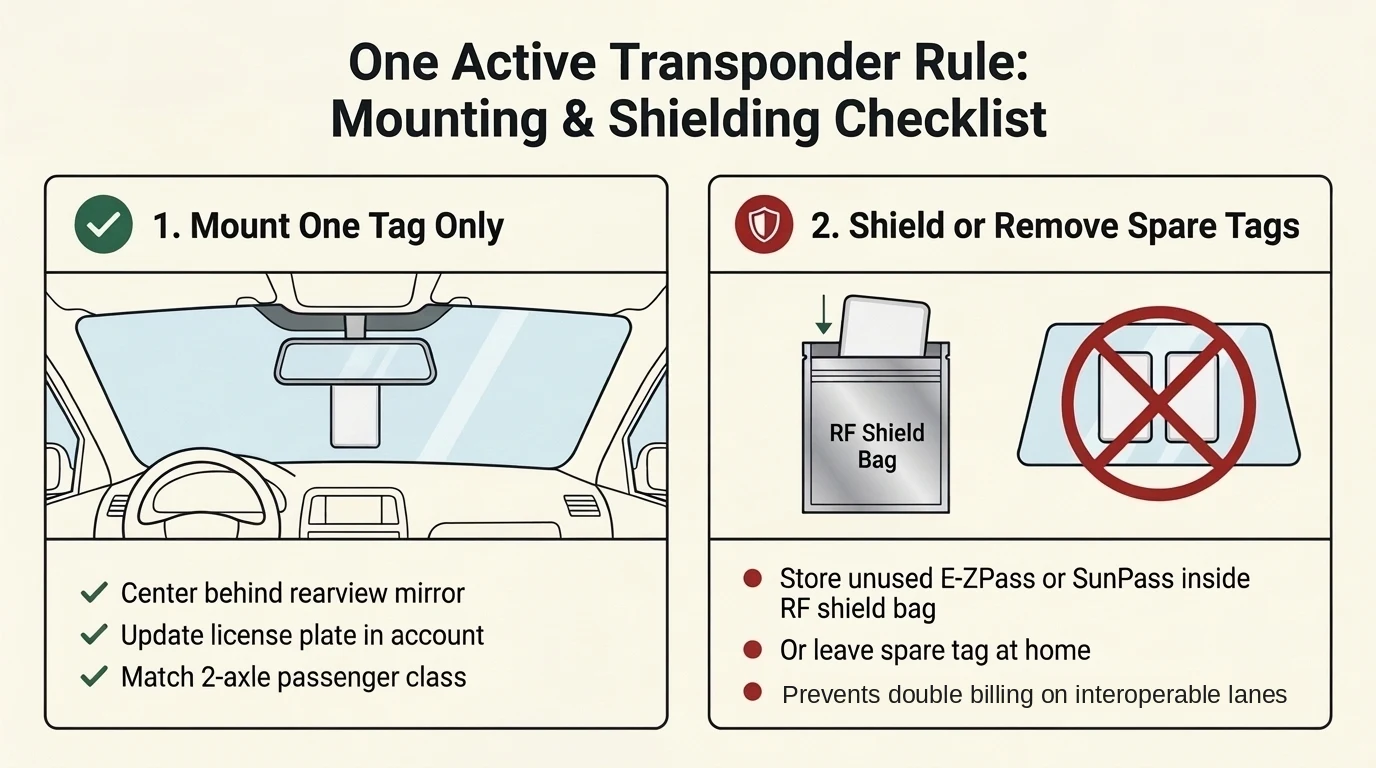
Keep only one active transponder on the windshield and isolate any spare tag inside an RF shield bag so interoperable gantries cannot bill two accounts at once.
If you discover charges for the exact same date and time on two different prepaid toll accounts after driving on CFX roadways, CFX advises contacting your home agency to assist with the dispute. Pack your RF shield bag alongside your spare key and vehicle documents during pre-trip prep using our car road trip checklist, and log shared highway tolls cleanly with passengers using our guide to splitting road trip gas and travel costs.
Why Don’t Older SunPass Tags Work on Northern E-ZPass Gantries?
Older battery-powered SunPass tags were phased out by the end of 2015 and SunPass Mini remains limited to six southern and central states because federal toll-interoperability legislation set a deadline without funding or penalties. Agencies therefore expanded compatibility gradually through hardware upgrades and regional agreements rather than one universal legacy standard.
SunPass was created in 1999 by the Florida Department of Transportation’s Office of Toll Operations, operating as a division of Florida’s Turnpike Enterprise, while the E-ZPass Interagency Group evolved separately across northeastern toll authorities. Under Public Law 112-141 Section 1512(b) enacted July 6, 2012 (codified as a note to 23 U.S.C. 129 on GovInfo), Congress directed that within 4 years all toll facilities on Federal-aid highways implement technologies or business practices providing for electronic toll collection interoperability.
Although MAP-21 aimed for nationwide interoperability by October 1, 2016, Congress provided no dedicated funding and established no penalties for missing that date. Florida phased out its older battery-powered SunPass models by the end of 2015, connected to CFX and E-ZPass in stages culminating in the May 28, 2021 SunPass PRO rollout, and later added statewide Texas and Colorado E-470 links in 2025. That phased rollout is why a permanent SunPass Mini sticker still stops at six states while SunPass PRO and E-ZPass bridge the corridor.
Before starting an interstate toll road trip, run through five quick checks:
- Verify your exact hardware model: confirm you have a SunPass PRO or E-ZPass before crossing north of North Carolina, rather than a permanent SunPass Mini sticker.
- Keep one active tag on the glass: leave any second transponder at home or seal it completely inside an RF shield bag.
- Update your license plate and balance ahead of time: allow up to 24 hours on your home E-ZPass network and up to 72 hours on partner networks for nightly reciprocity files to propagate.
- Check vehicle class and axle count: ensure a two-axle SunPass PRO is not used on a three-axle towing setup outside Florida, and verify your E-ZPass class matches the vehicle.
- Watch for independent toll exceptions: check ahead for non-participating bridges such as Gasparilla Bridge or Hammock Dunes Bridge in Florida and out-of-network systems like California’s FasTrak.
For more everyday driving and vehicle ownership topics, browse Car Lifestyle or view every guide in the driving blog.