A car battery maintainer supports a charged battery during storage through a controlled maintenance stage, such as float charging. A charger can do the same job when its manual explicitly supports long-term maintenance for your battery.
Before storage, check what the device does after a full charge: it should enter a documented maintenance mode suited to the battery’s voltage, chemistry and capacity. A low current rating, an automatic shutoff or the word “smart” does not establish that capability. For winter car storage, also check the unit’s operating-temperature range and arrange periodic inspections. Start with the comparison below, then verify the program and completed-charge indication in your exact model’s manual.
| Equipment | During preparation | After full charge | Storage decision |
|---|---|---|---|
| Charger without documented maintenance | Restores charge within its ratings | Finishes its charging cycle according to its instructions | Follow completion and disconnection instructions; arrange a separate storage plan. |
| Charger with documented maintenance | Charges the battery using its compatible program | Transitions to its supported maintenance function | Can serve both roles when the battery and storage conditions meet its instructions. |
| Dedicated maintainer | May also charge batteries within its charging ratings | Maintains charge using its documented control method | Check its charging capacity as well as maintenance compatibility; plan inspections. |
What does float charging actually do?
Float charging holds a fully charged lead-acid battery at a regulated maintenance voltage. It differs from continuing to apply a charging output without suitable control after the battery is full.
Battery Tender’s FAQs describe its float stage following bulk and absorption charging: the charger changes to a regulated voltage intended to maintain charge. CTEK’s MXS 5.0 North America product sheet describes a float/pulse maintenance system. Those are distinct control descriptions, so use the stages and indicators in your own manual to understand what the unit is doing.
This is why “charger versus maintainer” is an incomplete comparison. Some devices perform both functions. Equally, a charger that stops automatically may have completed its job without providing ongoing maintenance. Look for explicit long-term connection instructions and the battery types they cover.
An uncontrolled trickle charge is a different proposition. Trojan Battery’s Battery Maintenance guidance identifies excessive gassing, heat buildup and battery aging as effects of overcharging. A small output alone does not make prolonged charging appropriate. Select the supported battery program and let its documented charging sequence reach the required stage.
Match the maintainer to the battery and the garage
Use the battery label, vehicle handbook and maintainer manual together. The connection can fit physically while the electrical program is wrong.
Check these items before connecting:
- Nominal voltage: match the battery and charger ratings, especially when preparing a classic car whose electrical system may differ from a modern car’s.
- Chemistry and program: identify the battery type and select a program expressly approved for it. Follow separate lithium-specific instructions when that is the installed chemistry.
- Capacity: confirm that the battery falls within the unit’s applicable charging and maintenance ranges. Read both ranges if the manual distinguishes them.
- Condition: inspect the battery, terminals, leads and charger for damage. Resolve damage or a fault before beginning storage charging.
- Location: check ambient-temperature limits, ventilation and protection from the elements against the equipment instructions.
For winter car storage, compare the garage’s expected conditions with the exact model’s operating limits. Temperature compensation adjusts charging behavior; the equipment still has a permitted operating range. CTEK lists an ambient-temperature range separately from its charging programs in the North American MXS 5.0 manual, illustrating why both checks matter.
Never charge a frozen battery. Both CTEK’s manual and Trojan’s battery guidance give that instruction. If freezing is suspected, stop the charging plan and follow the battery manufacturer’s inspection and handling guidance.
What should you do before leaving the car connected?
Confirm the connection procedure, then observe the charger until it reaches the stage its manual requires for prolonged connection. Simply seeing a light turn on is insufficient.
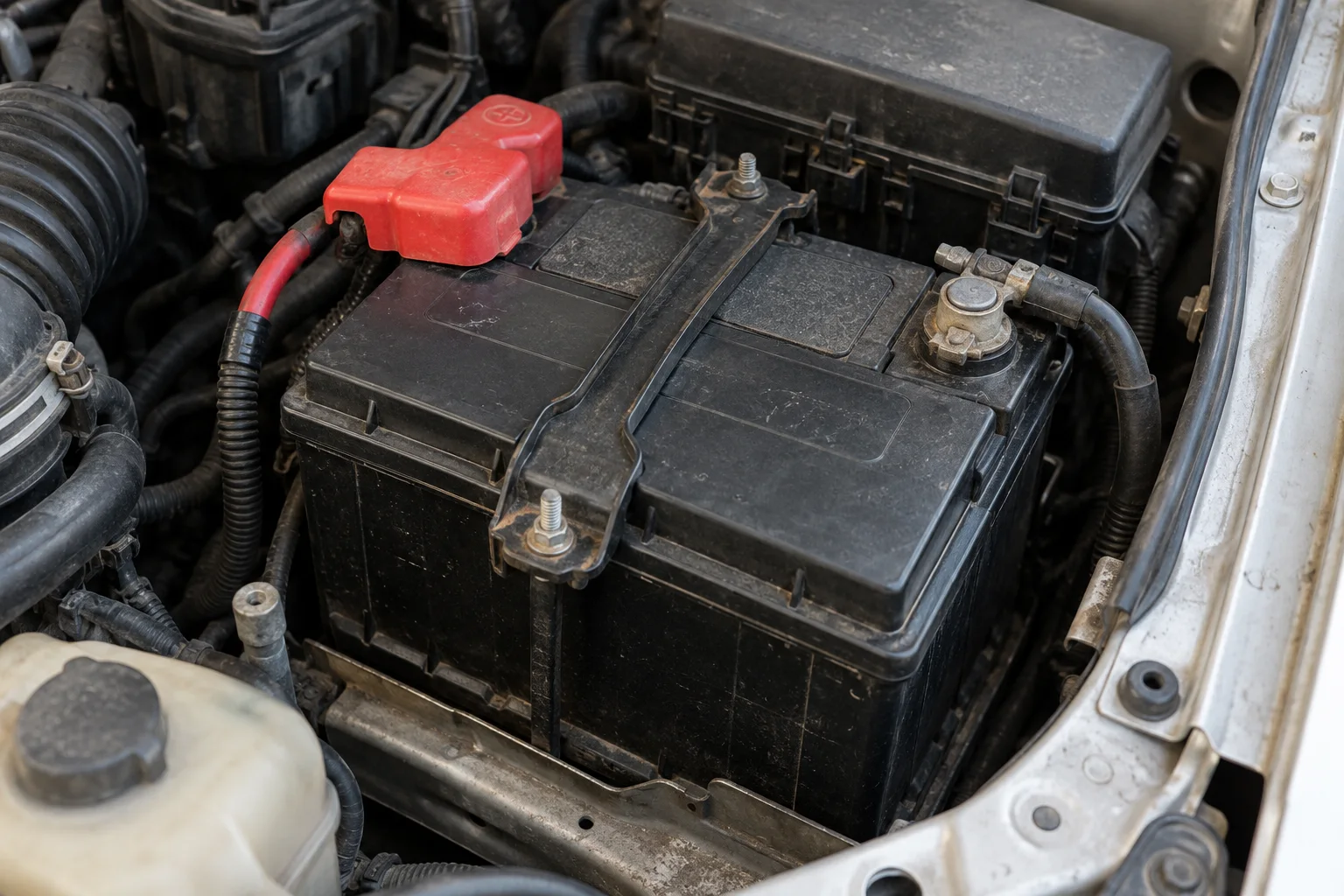
- Identify the vehicle’s approved charging points and ground polarity. Use the vehicle and battery instructions alongside the charger manual. When deciding how to store a classic car, verify which battery terminal is connected to the chassis before choosing a connection procedure. CTEK’s manual gives separate procedures for negative-ground and positive-ground vehicles.
- Keep AC power disconnected while attaching the charging clips. Follow the manual’s connection sequence and use the specified attachment points. Do not use a generic color-to-chassis shortcut across different vehicles.
- Place the unit and route its leads. Keep ventilation open and cables away from hot surfaces, sharp edges, moving parts, hood hinges and door pinch points. CTEK instructs owners to keep the charger away from the battery as far as its DC leads permit and never directly above it.
- Select the compatible program and begin charging as instructed. A suitable maintainer may handle the preparation charge itself within its ratings. Use the manual’s completion and error guidance to judge progress.
- Verify the required completed-charge or maintenance indication. Record what normal operation looks like for that model. If it reports an error or fails to reach the expected stage within its specified limit, follow its troubleshooting and disconnection instructions before leaving the car.
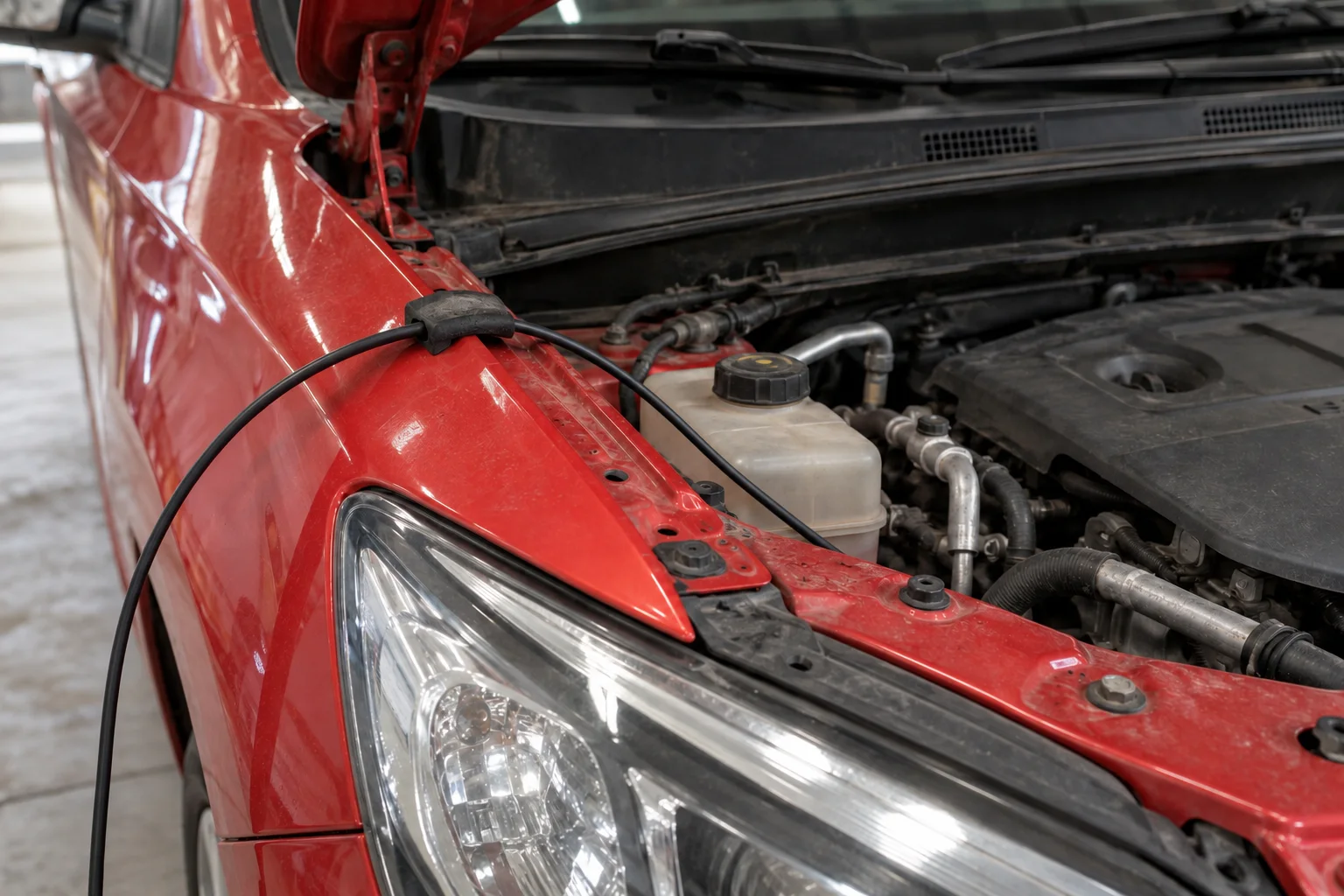
Battery removal is a vehicle-specific decision. Follow the vehicle manufacturer’s instructions for charging in place, disconnecting or removing the battery. If the instructions permit charging in the car, use the designated connection points and the matching ground-polarity procedure.
What should you check during storage?
Schedule checks even when maintenance is automatic. Battery Tender’s FAQs explicitly recommend periodic inspection, and CTEK requires owners to verify the prescribed charging stage before prolonged unattended connection.
At the interval specified for your equipment, check the indicator against the manual, look over the battery and cable insulation, and confirm that ventilation and cable clearance remain unobstructed. Check that the storage temperature remains within the permitted range. Keep the unit accessible so these checks can be performed without disturbing the connections.
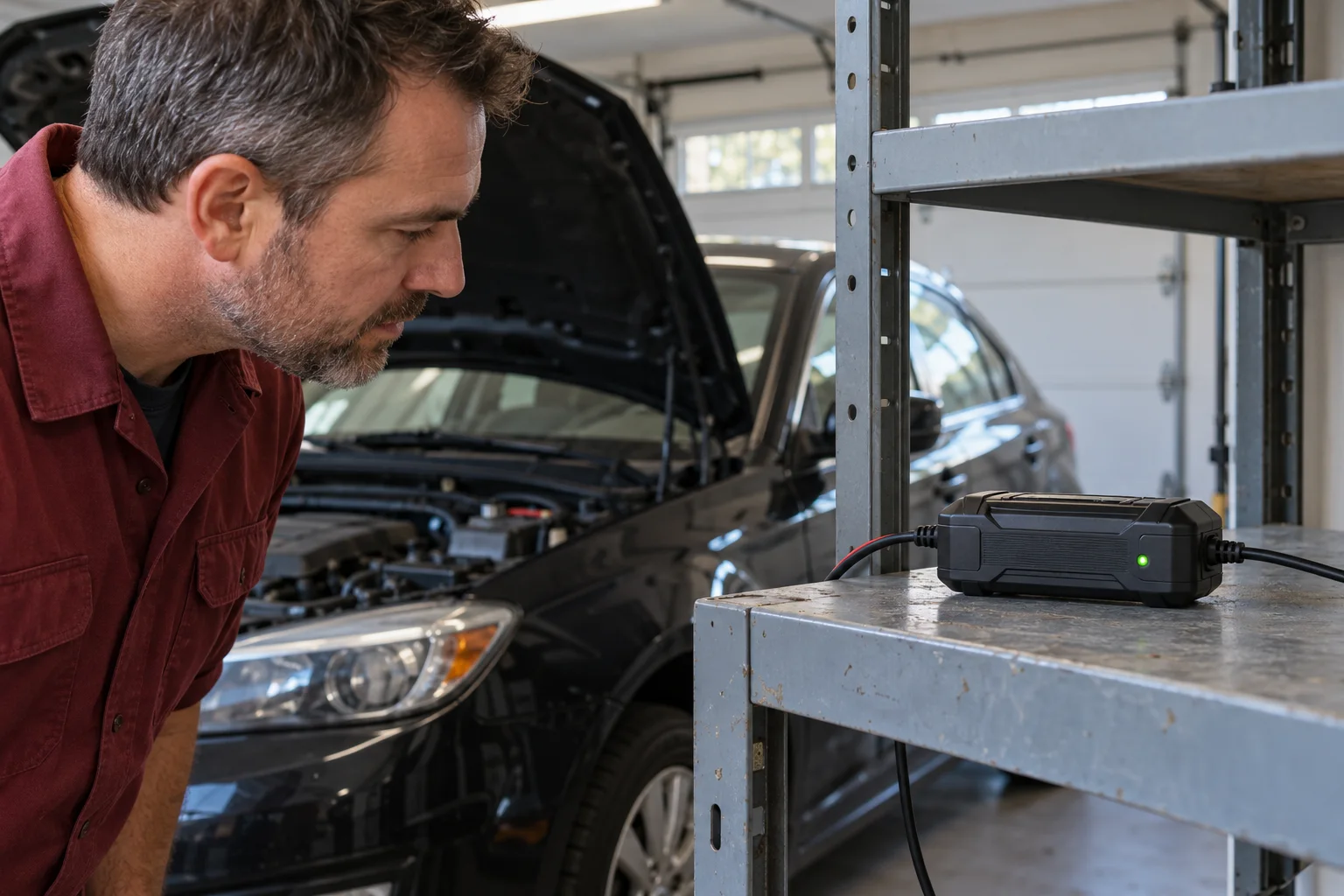
If an error appears or the battery fails to reach the expected stage, use the model’s troubleshooting instructions. Avoid repeatedly restarting a failed charge cycle as a storage routine. Damaged equipment or a battery fault needs attention before maintenance resumes.
Before returning the car to use, follow the charger’s shutdown and disconnection sequence, including removing AC power before handling charging clips. Then work through the pre-trip tires, fluids and brakes checklist as part of preparing the rest of the car.
What if the storage space has no continuous power?
Use a monitored storage-and-recharge plan from the battery manufacturer. Trojan’s lead-acid storage guidance calls for charging before storage, monitoring charge during storage and recharging as directed.
Arrange access to check the battery and recharge it with suitable equipment. Use the battery maker’s monitoring method and recharge criteria for your battery type. Follow the vehicle handbook if that plan involves disconnecting or removing the battery.
Before parking, put your intended storage dates, battery identification and exact maintainer manual together. Find the supported program, normal maintenance indication, operating limits and inspection instructions. That gives you a concrete plan for the battery; browse our car lifestyle and road-trip guides for planning the next drive.
Sources and document dates
Manufacturer documentation accessed October 27, 2026:
- Battery Tender — FAQs: charging stages, float behavior, automatic shutoff and periodic inspection.
- CTEK — MXS 5.0 North America User Manual, model 1090, copyright 2025: battery compatibility, charging precautions, ground polarity, cable routing, indicators and operating conditions.
- CTEK — MXS 5.0 North America product sheet: float/pulse maintenance description.
- Trojan Battery — Battery Maintenance, Storage and Charging sections: lead-acid storage, ventilation, overcharging and frozen-battery precautions.