Friends who share a car need the fuel split written down before the first fill-up. The miles each person rides, the card that pays each receipt, and the fuel left in the tank on the way home can all differ. This page shows two ways to recompute each share, then a four-column ledger: prepaid amount, amount actually paid, share owed, and the settlement difference.
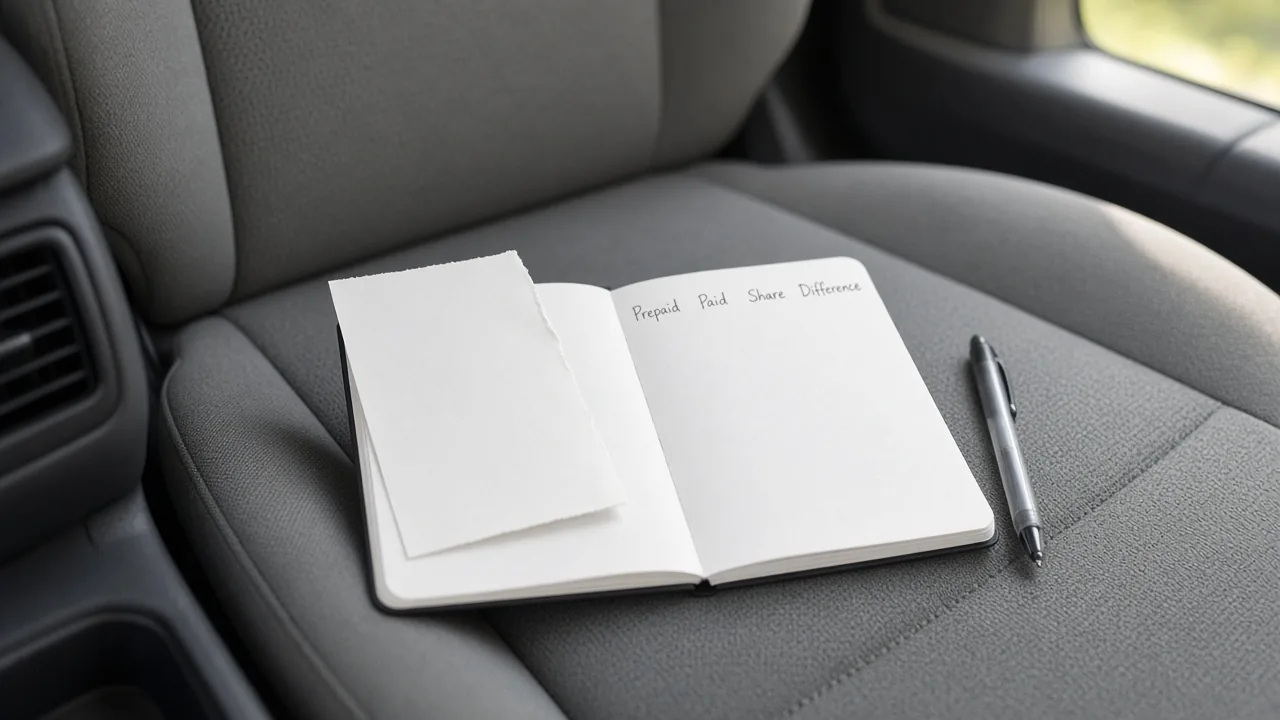
Use it for a shared gasoline car. Every dollar figure below is a hypothetical worksheet. The $4.00 price and the 20 miles per gallon are round blanks so you can recompute each line. They are a teaching example. They are not today’s pump price, a road test, or an official rule about what is fair. The picture above is an illustration of a blank slip and an empty notebook on a car seat. It does not show a receipt total or a real group’s settlement.
Packing, rest stops, and a one-line fuel estimate for the whole trip sit on the road trip checklist. That page’s budget answer is miles divided by mpg, times a price. This page starts after that estimate, when more than one person has to settle it. The checklist itself is not repeated here.
| What you are computing | Worksheet rule |
|---|---|
| Fuel account | Starting gallons + receipt gallons - ending gallons, then times the agreed price |
| Equal split | That fuel account divided by the people on the agreement |
| Segment split | Each segment’s cost divided by the people in the car for those miles |
| Settlement difference | Share owed - prepaid amount - amount actually paid |
Draw the boundary of the fuel account
The fuel account is the gasoline this trip consumed. Write three numbers, then stop adding.
Gallons used = gallons in the tank at departure + gallons printed on receipts during the trip - gallons in the tank at the end.
Multiply gallons used by the price your group wrote on the worksheet. That product is the fuel cost you split. One account, one time.
A receipt records a purchase. Fuel the trip consumed can be larger or smaller than that purchase. Gasoline already in the tank at departure was bought earlier, often by the person who brought the car, and this trip has no receipt for it. Gasoline still in the tank at the end stays with the car. Split the receipts alone and you skip both readings. Add the departure budget on top of the receipts and you bill the same gasoline a second time.
The whole-car estimate you use for the budget comes from public calculators that stop at the vehicle. FuelEconomy.gov’s Trip Calculator lets a user edit miles per gallon and fuel price, enter a start, stops, and a destination, and drag the route on the map. The page says Oak Ridge National Laboratory administers the site for the U.S. Department of Energy and the U.S. Environmental Protection Agency. A Department of Energy note dated June 6, 2022, says the calculator compares fuel cost for a route and a vehicle, and that a user can change the fuel price and the share of city driving. This article did not run the calculator, and it does not use the sample prices in that 2022 note. The calculator has no passenger field.
The Zebra’s fuel cost page, which carries an update date of July 20, 2026, states the same whole-car steps: divide miles by the vehicle’s miles per gallon, then multiply the gallons by a fuel price. That page does not divide the result among the people in the car. The split in the tables below is worksheet arithmetic. It is not a Department of Energy formula.
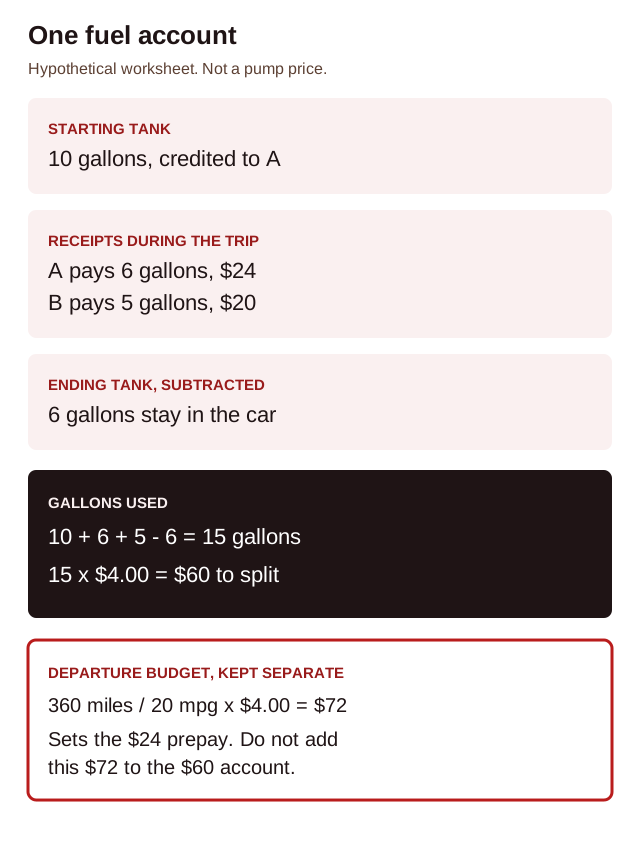
Takeaway: Settle gallons used. Hold the departure budget aside as the figure that set the prepay.
Set the departure budget, then replace it
Before anyone drives, fill four blanks: planned miles, miles per gallon, price per gallon, and the prepay each person will hand over.
Hypothetical budget, using the same round blanks as the rest of this page:
| Blank | Value written on the sheet |
|---|---|
| Planned miles | 360 |
| Miles per gallon | 20 |
| Price per gallon | $4.00 |
| Gallons (360 ÷ 20) | 18 |
| Departure budget (18 × $4.00) | $72 |
Three people in this hypothetical, called A, B, and C, each put $24 in an envelope. The envelope holds $72. That cash is a credit against a later share. It is a deposit, and it is not a count of fuel used.
A thread on DISboards, with posts dated January 2, 2018, asks how friends can share gas and other costs that are still unknown, without one person draining a card. One reply says the group put gas money in an envelope at the start of past trips. Another says to estimate, collect cash ahead of time, and settle the gap at the end. Those replies do not log who was in the car on each leg, and they do not adjust the tank. They are not a finished segment settlement. The dollar examples in that thread cover hotels, tickets, and food. This page leaves those costs out, and it does not recommend a prepaid card or a rewards card.
One hypothetical trip, from tank to receipts
A brought the car and the starting fuel. B rode every mile and paid one receipt. C rode only the middle leg. These labels are for the arithmetic. They are not a record of a real group.
The worksheet price stays $4.00 per gallon. The miles-per-gallon blank stays 20. Segment miles are round values chosen so each step divides evenly.
| Segment | Miles | People in the car | Gallons (miles ÷ 20) | Cost (gallons × $4.00) |
|---|---|---|---|---|
| 1. Home to the meetup | 80 | A, B | 4 | $16 |
| 2. Out and back from the meetup | 120 | A, B, C | 6 | $24 |
| 3. Meetup to home | 100 | A, B | 5 | $20 |
| Logged total | 300 | 15 | $60 |
Tank on the same sheet:
- Departure reading: 10 gallons. Credit them to A.
- Receipt: A pays for 6 gallons, $24.
- Receipt: B pays for 5 gallons, $20.
- Return reading: 6 gallons still in the tank. Subtract them.
Gallons used = 10 + 6 + 5 - 6 = 15. The segment log also totals 15 gallons. In this made-up sheet the two routes into the fuel account agree. On a real drive they may not. If they disagree, pick one total in writing before anyone sends money. This match is part of the example. It is not a test of a car.
Cost of gallons used = 15 × $4.00 = $60.
Amount actually paid on this hypothetical:
- A: $24 on a receipt, plus the net tank drawdown of (10 - 6) × $4.00 = $16. A’s paid column is $40.
- B: $20 on a receipt.
- C: $0.
Receipts sum to $44. The fuel account is $60. The $16 difference is the fuel that left the tank and never appeared on a trip receipt. The departure budget was $72, because it assumed 360 miles and 18 gallons. The log used 300 miles and 15 gallons. You settle $60. You do not settle $72, and you do not settle $72 plus $44.
If the return reading is higher than the departure reading, the drawdown is negative. Reduce the supplier’s paid column by that extra fuel, because the car is holding gasoline the trip bought. If a receipt was paid from the envelope rather than from someone’s own card, keep the receipt in the fuel account and leave it out of every person’s paid column. The prepaid column already records that cash.
Split the whole trip equally
Method 1 divides the fuel account by the number of people on the agreement. It does not look at who rode which miles. Use it when everyone has already agreed to an equal fuel share, including a person who joins late or leaves early.
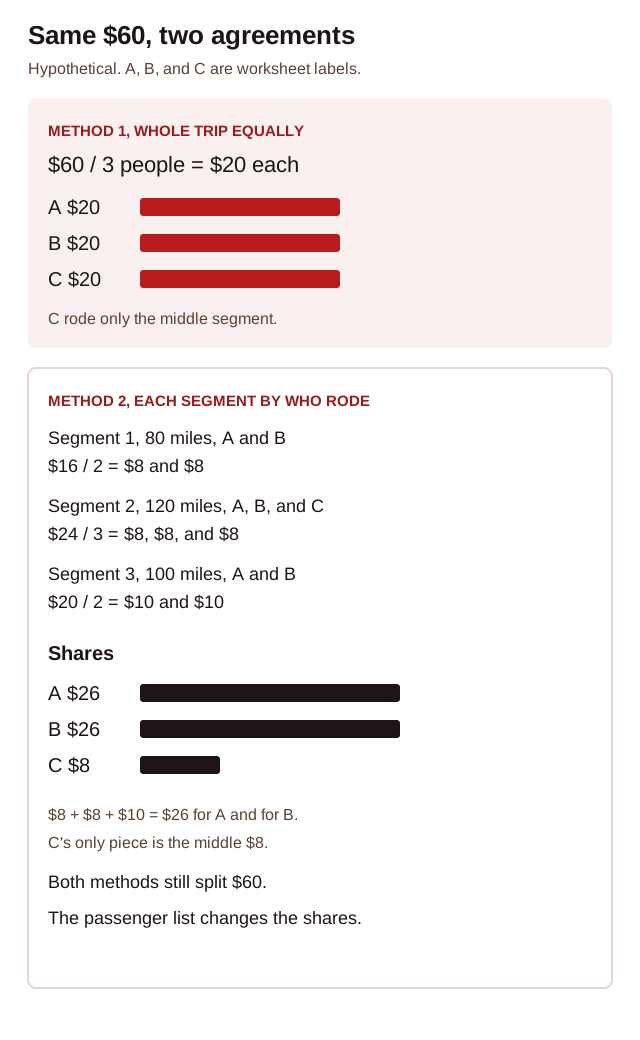
Share = $60 ÷ 3 = $20.
| Person | Prepaid amount | Amount actually paid | Share owed | Settlement difference |
|---|---|---|---|---|
| A | $24 | $40 | $20 | -$44 |
| B | $24 | $20 | $20 | -$24 |
| C | $24 | $0 | $20 | -$4 |
Settlement difference = share owed - prepaid amount - amount actually paid.
A negative number means the group pays this person that amount. A positive number means this person still owes the group.
Check the pot. The three differences are -$44, -$24, and -$4. They sum to -$72, the cash in the envelope. A receives $44, B receives $24, and C receives $4. The envelope is empty, and no one writes a new check. C prepaid $24 and owes $20, so C’s refund is the $4 left over. B’s $20 receipt already equals B’s $20 share, so B’s refund is the entire $24 prepay. A paid $40 of a $20 share, so A’s refund is the $24 prepay plus $20 of the fuel A covered for the others.
Method 1 is finished if equal shares are the agreement you made before departure. C rode 120 of the 300 miles and still owes $20, the same share as A and B. If that result is a surprise, you wanted method 2, and you should have named it before the trip.
Split each segment by who was in the car
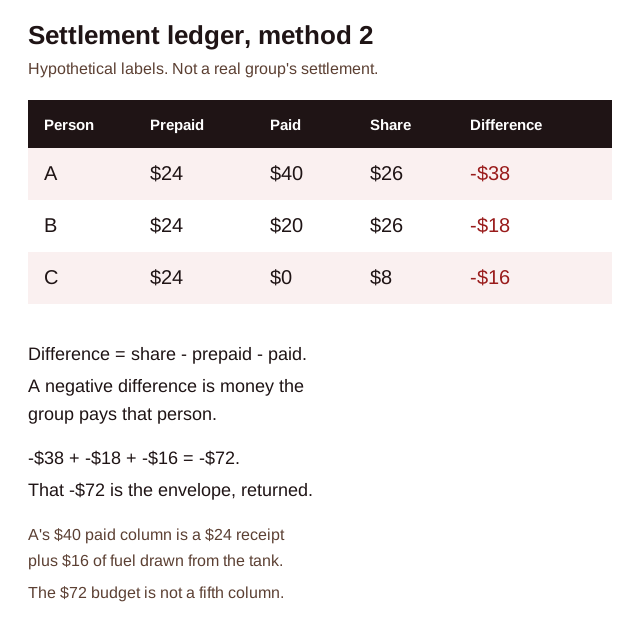
Method 2 opens a new segment when someone joins or leaves. Divide that segment’s cost by the people in the car for those miles. Add the pieces to get each person’s share.
- Segment 1: $16 ÷ 2 = $8 for A and $8 for B.
- Segment 2: $24 ÷ 3 = $8 for A, $8 for B, and $8 for C.
- Segment 3: $20 ÷ 2 = $10 for A and $10 for B.
A’s share = $8 + $8 + $10 = $26. B’s share = $26. C’s share = $8. The shares sum to $60, the same fuel account as method 1.
| Person | Prepaid amount | Amount actually paid | Share owed | Settlement difference |
|---|---|---|---|---|
| A | $24 | $40 | $26 | -$38 |
| B | $24 | $20 | $26 | -$18 |
| C | $24 | $0 | $8 | -$16 |
The differences sum to -$72 again. The envelope still clears. A receives $38, B receives $18, and C receives $16. C’s refund rises from $4 under method 1 to $16 under method 2, because C’s share falls from $20 to $8. The prepaid column did not change. The share column did.
Write the segment when the doors open: odometer, people in the car, and who will pay the next receipt. A segment with one person is that person’s full cost for those miles. A gap in the log is a missing segment, and it is not a zero.
Takeaway: Recompute shares when the passenger list changes. Keep the fuel account at the gallon total you already agreed.
A driver discount stays voluntary
Some groups want the driver to pay less. Write the discount in dollars before you leave. Apply it only after the share column exists, and keep the fuel account at the same $60. Nothing on this page sets the discount for you. A tax mileage rate is a different system, and this worksheet does not use one.
Hypothetical add-on, and only if the group agreed: move $6 off A’s method 2 share, and add $3 to B and $3 to C.
| Person | Share after the $6 shift | Settlement difference |
|---|---|---|
| A | $20 | -$44 |
| B | $29 | -$15 |
| C | $11 | -$13 |
-$44 + -$15 + -$13 = -$72. The pot still clears. Skip the shift if the group did not agree to it. Do not invent a discount at the curb so the driver comes out even.
Insurance, a deductible, and a repair are not gallons. Leave them off this sheet.
Close the sheet at the end of the drive
- Note the return fuel level before anyone leaves the car.
- List each receipt: gallons, dollars, and the person who paid.
- Recompute gallons used from the tank formula.
- If the segment miles imply a different gallon total, agree on one total and rebuild the share column from that total.
- Fill prepaid, amount actually paid, share owed, and settlement difference.
- Pay the differences. File the departure budget with the notes. Do not add it to the receipts.
Common mistake: Adding the envelope total to the pump receipts and splitting that sum. The envelope is a credit in the prepaid column. The fuel account is the tank formula. Those are different lines.
What this worksheet leaves out
A full trip budget, a tax mileage rate, insurance, and repair liability belong in other agreements. The road trip checklist covers car prep, packing, and where you stop for fuel. Its budget line estimates fuel for the car. It does not settle passengers. A payment app can carry the settlement difference from one friend to another. This page does not pick an app or a card. Two groups can choose method 1 and method 2 on the same highway. Each group is keeping its own agreement. Neither method is a required standard of fairness.
Other notes from this site are listed on the blog.
Methods and sources
The public pages were read on October 12, 2026, from copies saved on October 11, 2026. The Trip Calculator page describes editable miles per gallon, fuel prices, stops, and a route, and it names Oak Ridge National Laboratory as the administrator for the Department of Energy and the EPA. The Department of Energy note of June 6, 2022, confirms what that calculator is for. The Zebra fuel page states the whole-car miles, miles-per-gallon, and price product and does not split passengers. The DISboards thread is a real question about shared trip payments, with informal answers about an envelope and paying ahead. Those answers are not a segment settlement.
The $4.00 price, the 20 miles per gallon, the miles, the tank readings, and the labels A, B, and C are hypothetical. Replace every one of them with the numbers your group writes down. The calculator was not run to produce a figure for this article.