You can pull into a highway safety rest area to take a short break, use the restrooms, shake off drowsiness, or take a nap inside your parked vehicle, provided you stay within that state’s time limit and follow the sign posted at the entrance. Federal Highway Administration (FHWA) Interstate guidance defines safety rest areas as places for motorists to take a short break, use the rest rooms, shake off drowsiness, and move on, while the California Department of Transportation (Caltrans) explicitly lists taking a nap among the uses of a Safety Roadside Rest Area as a safe alternative to parking along the roadside.
No single national hour cap governs rest stop overnight parking across the United States. State statutes, administrative rules, and agency brochures set distinct limits: eight hours in a twenty-four hour period in California’s quoted regulation and in Washington’s statute, three hours in Florida’s rule text (alongside a separate ten-hour commercial-driver sentence on FDOT’s Q&A page), up to 24 hours in Texas under Transportation Code Section 545.411, and an overnight stay prohibition in North Carolina’s rest-area brochure. Across our road trip planning guides and the wider driving journal, rest-stop rules work alongside realistic daily driving distance limits so you know when a quick nap is enough and when you need a motel or commercial stop off the highway.
Can You Sleep in Your Car vs. Camp at a Rest Stop?
State transportation rules separate resting inside a parked vehicle from setting up a camp outside on the grounds. On its Safety Roadside Rest Areas page, Caltrans states that rest areas give travelers opportunities to safely stop, stretch, take a nap, use the restroom, get water, check maps, place telephone calls, switch drivers, check vehicles and loads, and exercise pets. In its Maintenance Manual Chapter G (Public Facilities, June 2024), Caltrans quotes California Code of Regulations, Title 21, Section 2205 in part: no camping, no parking or remaining for more than eight hours in any twenty-four hour period, no pitching of tents or erection of other shelter, and no building or maintaining campfires or other open fires.
Washington, Florida, Texas, and North Carolina each state a separate camping, tent, shelter, or fire limit:
- In Washington, RCW 47.38.020 makes it unlawful (except where specifically authorized by the department) to camp or to maintain a camp, tent, or other sleeping accommodation or facility in a safety rest area, and WAC 468-32-010 states that open fires are prohibited.
- In Florida, Florida Administrative Code Rule 14-28.002 states in subsection (2) that camping is prohibited, and FDOT’s Rest Area Information page states that overnight camping is not permitted while visitors may stay for up to three hours.
- In Texas, Transportation Code Section 545.411 pairs staying longer than 24 hours with erecting a tent, shelter, booth, or structure at a rest area when statutory notice applies.
- In North Carolina, the NCDOT rest-area brochure prohibits loitering, camping, soliciting, consuming alcoholic beverages, and staying overnight.
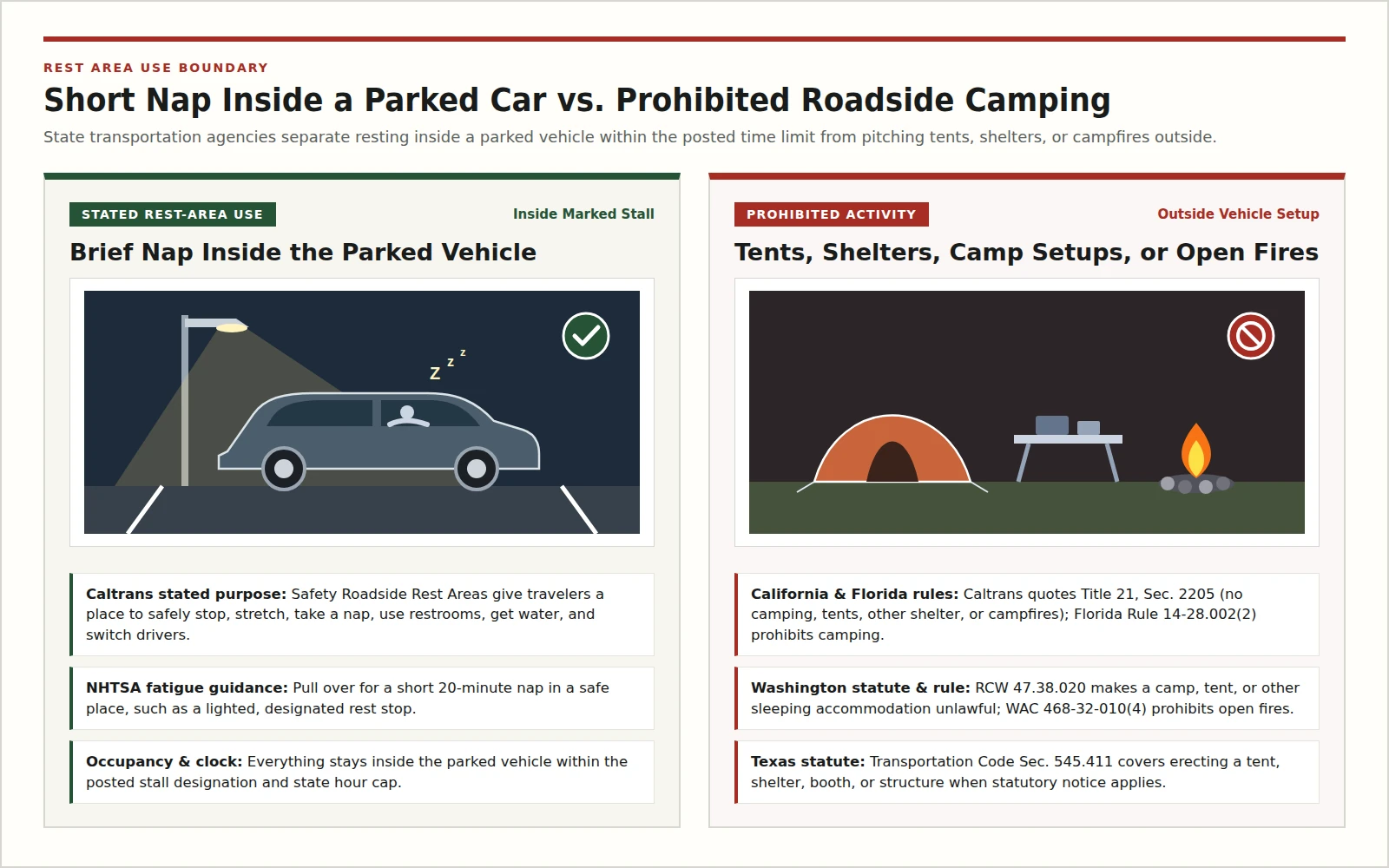
Caltrans lists taking a nap among stated Safety Roadside Rest Area uses, while the Chapter G quotation prohibits camping, tents, other shelter, and campfires, Washington’s statute makes a camp, tent, or other sleeping accommodation unlawful, Florida’s rule prohibits camping, and Texas’s statute covers a tent, shelter, booth, or structure when statutory notice applies (open full-size fig-01.webp).
How Safe Is a Short Nap at a Highway Rest Stop?
NHTSA advises a lighted, designated rest stop when drowsiness starts, and Caltrans calls a rest area a safe and convenient alternative to unsafe parking along the roadside. On its Drowsy Driving page, the National Highway Traffic Safety Administration (NHTSA) advises drivers who start to get sleepy to drink one to two cups of coffee and pull over for a short 20-minute nap in a safe place, such as a lighted, designated rest stop. Caltrans likewise notes that rest areas reduce drowsy and distracted driving, provide a safe and convenient alternative to unsafe parking along the roadside, and use good lighting and security features to allow comfortable use 24 hours a day.
NHTSA’s crash records show why highway agencies build dedicated pull-offs for tired motorists while keeping two distinct reporting years separate:
- In 2024, NHTSA recorded 644 deaths from drowsy-driving-related crashes, while noting that determining a precise number of drowsy-driving crashes, injuries, and fatalities is not yet possible.
- In a separate 2017 estimate, NHTSA estimated that 91,000 police-reported crashes involved drowsy drivers, leading to an estimated 50,000 people injured and nearly 800 deaths.
- Drowsy-driving crashes occur most frequently between midnight and 6 a.m. or in the late afternoon, frequently occur on rural roads and highways, and often involve only a single driver (with no passengers) running off the road at a high rate of speed with no evidence of braking.
That coffee step still leaves the microsleep risk NHTSA describes for a seriously sleep-deprived driver. NHTSA warns that a seriously sleep-deprived driver who drinks coffee may still experience microsleeps lasting four or five seconds; at 55 miles per hour, that means traveling more than 100 yards down the road while asleep. Getting adequate sleep on a daily basis is the only true way NHTSA names to protect yourself against drowsy driving, with experts urging seven to eight hours of sleep per night, and NHTSA also says to avoid any alcohol before driving, which interacts with sleepiness to increase drowsiness and impairment, and to avoid peak sleepiness windows between midnight and 6 a.m. and in the late afternoon. Treat NHTSA’s 20-minute nap as an immediate alertness break rather than permission to park beyond a state’s posted maximum stay.
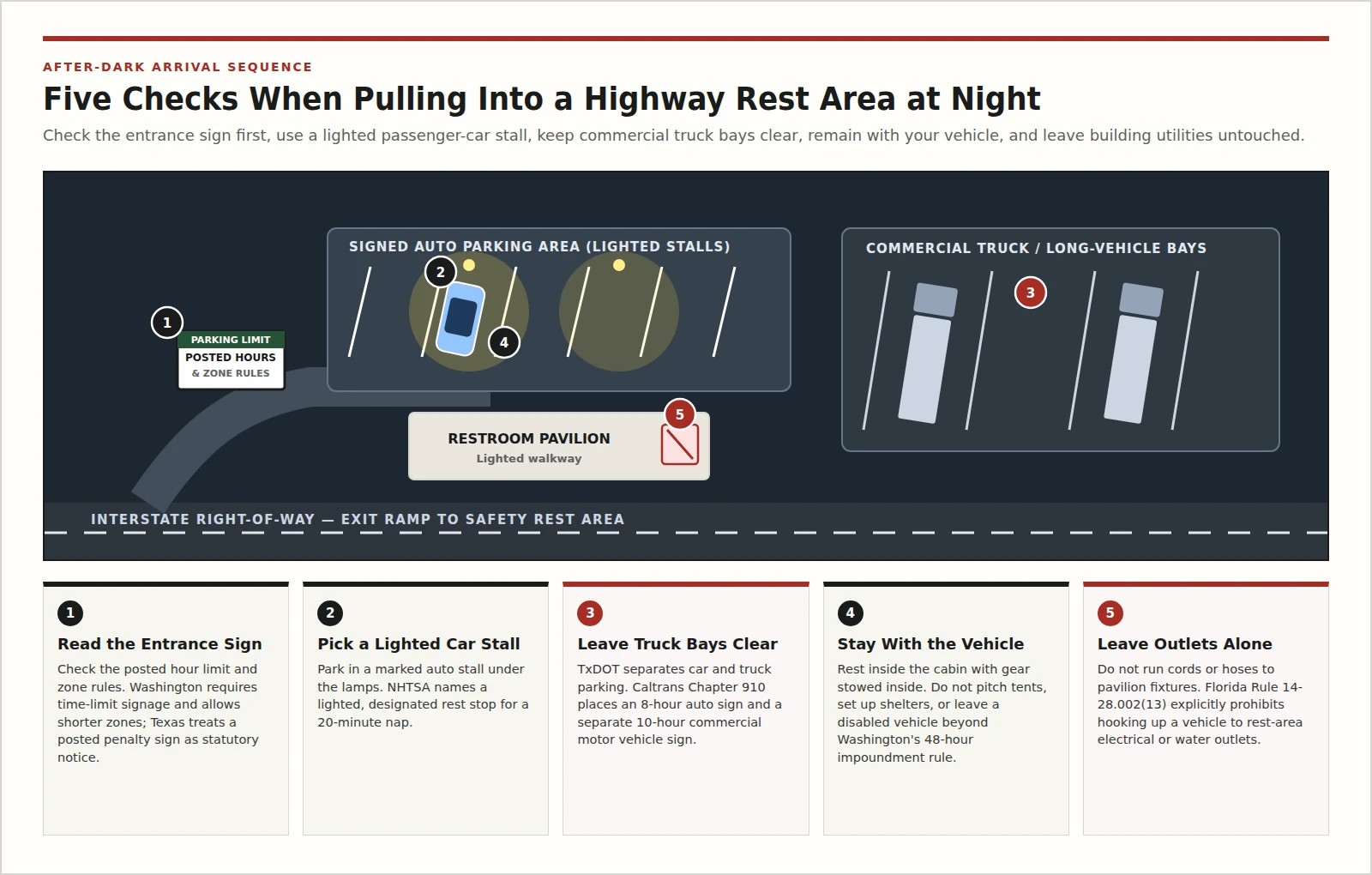
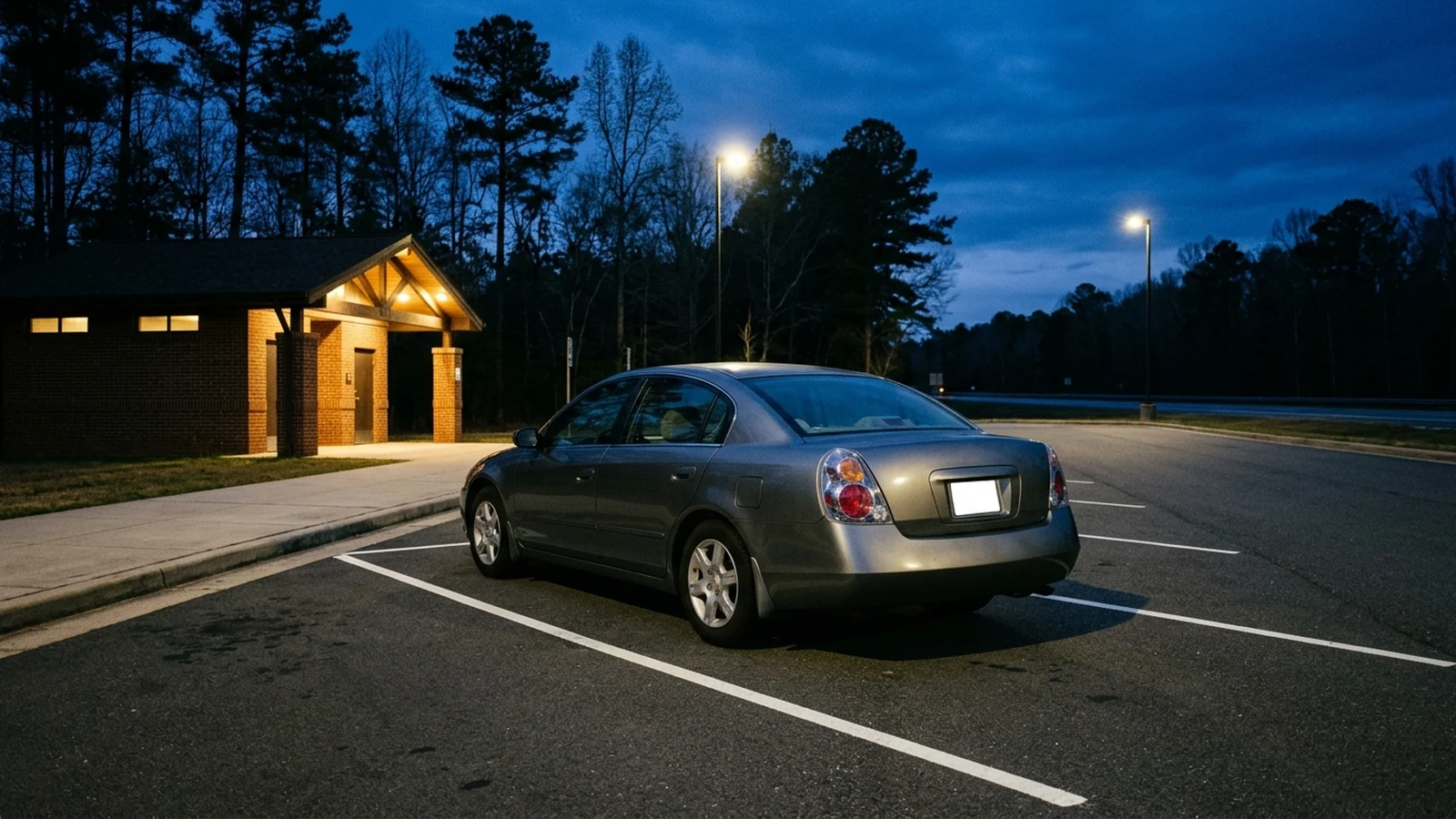
Five arrival checks after dark: read the posted entrance sign, park in a lighted designated car stall, leave long bays to commercial trucks, stay with your vehicle, and do not hook up to building utilities (open full-size fig-02.webp).
What Are the State Time Limits and Overnight Rules?
Rest areas in the United States are typically maintained and funded by state departments of transportation (Wikipedia, Rest area), so parking caps and overnight rules come from each state’s statutes, administrative code, and posted entrance signs rather than a uniform federal clock. Being open 24 hours a day also differs from permission to park for 24 hours: Florida and North Carolina keep rest-area buildings open around the clock while restricting how long a visitor may stay.
| State | General Stay or Overnight Rule | Commercial Vehicle & Special Clauses | Primary Document & Sign Notes |
|---|---|---|---|
| California | Up to 8 hours in any 24-hour period; no camping, tents, shelter, or campfires | Separate Highway Design Manual Chapter 910 sign instruction specifies an 8 Hour Parking sign for autos and a 10 Hour Parking Commercial Motor Vehicles sign for long vehicles | Caltrans Maintenance Manual Chapter G (June 2024) quoting Title 21, Sec. 2205 in part; the 8 Hour Parking sign states facilities within 7 miles count as the same facility |
| Washington | Up to 8 hours within a 24-hour period; unlawful to camp or maintain a camp, tent, or other sleeping accommodation | Commercial vehicles may park up to an hour beyond federally mandated rest periods; disabled vehicles face mandatory impoundment after 48 hours | RCW 47.38.020 requires posted time-limit signs and allows shorter zones; WAC 468-32-010 requires designated parking and bans open fires |
| Florida | Parking for periods greater than 3 hours is prohibited; camping is prohibited | FDOT’s Rest Area Q&A page states 3 hours for the general public and 10 hours for commercial motor vehicle operators subject to hours-of-service regulations | Rule 14-28.002 PDF (amended through 11-19-07) states the 3-hour parking cap and bans electrical or water hookups; the FDOT Rest Area Info page states visitors may stay for up to three hours |
| Texas | Visitor length of stay up to 24 hours under Transportation Code Sec. 545.411 | TxDOT rest areas provide larger parking lots with separated areas for cars and commercial trucks | Sec. 545.411 offense covers remaining over 24 hours or erecting a tent, shelter, booth, or structure when statutory notice applies (including a posted penalty sign or 8 hours after notice) |
| North Carolina | Staying overnight, camping, loitering, soliciting, and alcohol consumption are prohibited in NCDOT’s brochure | Custodians staff rest areas 8 to 16 hours each day (a staffing schedule, not a visitor stay limit) | NCDOT Rest Areas web page and brochure PDF state facilities are open 24 hours every day for convenient, brief stops |
| Colorado (Shaw Creek notice) | Check the posted sign at the specific rest-area entrance | Reconstructed Shaw Creek Rest Area provides expanded, safer parking for cars and commercial freight trucks | CDOT October 2026 reopening announcement describes car and freight-truck parking capacity rather than a statewide stay-hour rule |
California: Four Distinct Caltrans Documents
Caltrans provides Safety Roadside Rest Areas as part of the State Highway System under California Streets and Highways Code Sections 218-226.5, and master-plan research collected traffic and user data at 87 existing Safety Roadside Rest Areas. When checking California stay rules, keep the agency’s regulation quotation, sign legend, and sign-design manual in their own documents:
- Maintenance Manual Chapter G (June 2024) quotes California Code of Regulations, Title 21, Section 2205 as providing in part that camping is prohibited, vehicles shall not be parked and persons shall not remain for more than eight hours in any twenty-four hour period, pitching tents or erecting other shelter is prohibited, and building or maintaining campfires or other open fires is prohibited.
- The 8 Hour Parking sign specification prints the posted legend stating that unauthorized vehicles parked for more than 8 hours within a roadside rest or vista point may be towed at the owner’s expense, and adds that facilities within 7 miles of each other are considered to be the same facility.
- Highway Design Manual Chapter 910 instructs highway designers to provide an 8 Hour Parking sign at the entrance to the auto parking area and a 10 Hour Parking Commercial Motor Vehicles sign at the entrance to the long-vehicle parking area.
Washington: Statutory Cap, Posted Zones, and Commercial Rule
Washington’s WSDOT rest-areas directory lists locations and amenities across the state, while the legal time limit lives in RCW 47.38.020. Under RCW 47.38.020, except where specifically authorized by the department, it is unlawful to stop, stand, or park any vehicle (including trailers, campers, and motorcycles) for more than eight hours within a twenty-four hour period, or to camp or maintain a camp, tent, or other sleeping accommodation or facility in any safety rest area on interstate or state highway right-of-way.
Three additional clauses in RCW 47.38.020 affect how you read a Washington lot at night. First, the department must post signage consistent with RCW 46.55.070(1) regarding the parking time limits and may designate zones within a safety rest area with shorter parking time limits for efficiency and safety. Second, commercial vehicles may park up to an hour beyond federally mandated rest periods. Third, stopping, standing, or parking a disabled vehicle (including trailers, campers, and motorcycles) in a safety rest area for more than forty-eight hours is unlawful, after which the vehicle is subject to mandatory impoundment under RCW 46.55.080(1).
Florida: Rule 14-28.002 Text vs. FDOT’s Q&A Sentence
Florida’s rest areas and welcome centers are open and maintained 24 hours a day, 7 days a week (FDOT Rest Area Information). Rule 14-28.002 provides those stops on a first come, first served basis. In the Florida Administrative Code Rule 14-28.002 PDF hosted by FDOT (whose history line ends with an amendment on 11-19-07), subsection (2) states that camping is prohibited and subsection (4) states that parking for periods greater than three hours is prohibited, matching the Rest Area Information page statement that overnight camping is not permitted and visitors may stay for up to three hours. Separately, on FDOT’s Rest Area Questions and Answers page, FDOT states that the Florida Administrative Code rule permits a period of three hours for the general public and a period of ten hours for commercial motor vehicle operators subject to hours-of-service regulations.
Texas: Up to 24 Hours and the Notice Element in Section 545.411
On its Safety Rest Area Map page, the Texas Department of Transportation (TxDOT) lists visitor length of stay as up to 24 hours under Texas Transportation Code 545.411. Section 545.411 defines a rest area to mean public real property designated as a rest area, comfort station, picnic area, roadside park, or scenic overlook by TxDOT. Under that statute, a person commits an offense if the person remains at a rest area for longer than 24 hours or erects a tent, shelter, booth, or structure at the rest area and either has notice while conducting the activity that it is prohibited (including when a sign stating the prohibited activity and penalty is posted on the premises) or receives notice that the activity is prohibited and fails to depart or remove the structure within eight hours after receiving notice.
North Carolina and Colorado: Brief Stops, Staffing, and Facility Notices
North Carolina shows why travelers must check more than open hours. Both NCDOT’s Rest Areas page and NCDOT’s rest-area brochure state that North Carolina’s highway rest areas are open 24 hours every day to offer convenient, brief stops with roadside access to public restrooms and drinking water. The NCDOT brochure explicitly states that loitering, camping, soliciting, consuming alcoholic beverages, and staying overnight are prohibited at North Carolina’s Rest Areas, and its separate note that custodians staff rest areas from 8 to 16 hours each day describes attendant work shifts rather than a visitor parking allowance.
For states outside California, Washington, Florida, Texas, and North Carolina, check that state transportation department’s rest-area rules and the sign at the ramp rather than assuming a neighboring state’s cap applies. For instance, CDOT’s October 2026 announcement on the completed Shaw Creek Rest Area describes expanded and safer parking for cars and commercial freight trucks without stating a statewide stay-hour cap.
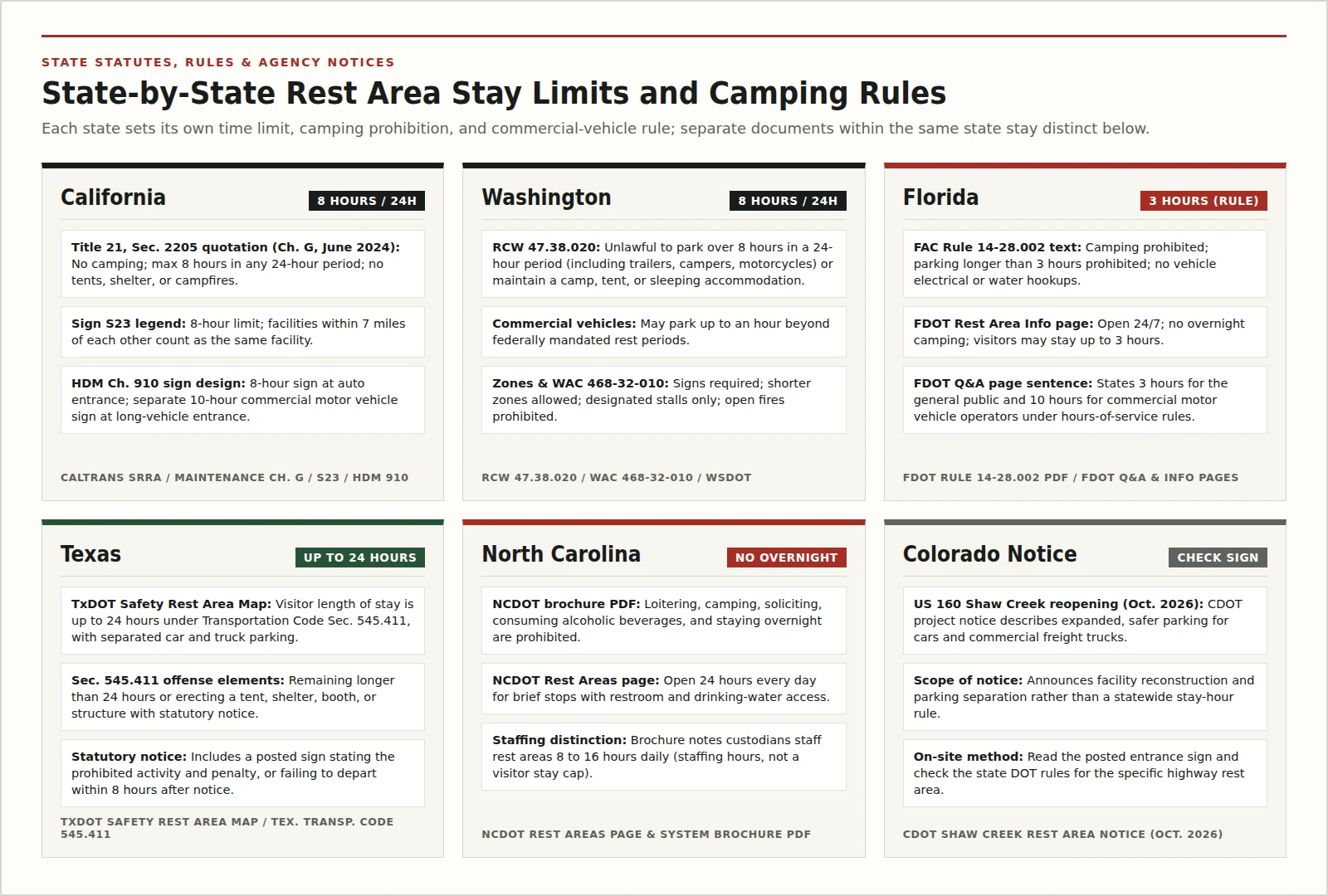
Published stay limits and camping rules across California, Washington, Florida, Texas, North Carolina, and CDOT’s Shaw Creek rest-area notice (open full-size fig-03.webp).
How Do Car Stalls, Truck Bays, and RV Rules Differ?
Passenger cars, recreational vehicles, trailers, and commercial freight trucks share highway rest-area ramps, yet their stalls, utility rules, and time limits are separated on the pavement. TxDOT builds larger rest-area parking lots with separated areas for cars and commercial trucks, CDOT’s Shaw Creek rest area provides parking for both cars and commercial freight trucks, and Caltrans Highway Design Manual Chapter 910 places an 8 Hour Parking sign at the auto entrance and a 10 Hour Parking Commercial Motor Vehicles sign at the long-vehicle entrance.
Follow four vehicle-specific rules whenever you pull in to rest:
- Park only in a designated parking area. Washington’s WAC 468-32-010(1) states that parking is only permitted in designated areas, and Florida’s Rule 14-28.002(5) states that all vehicles must be parked in the proper manner at locations designated by the department. TxDOT separates car parking from commercial-truck parking, and Caltrans places a separate commercial-motor-vehicle parking sign at the long-vehicle entrance.
- Count trailers, campers, and motorcycles under the vehicle clock. Washington’s RCW 47.38.020 applies its eight-hour limit within a twenty-four hour period to any vehicle, including trailers, campers, and motorcycles.
- Do not connect to building power or water. Florida’s Rule 14-28.002(13) states that no person shall hook up his or her vehicle to electrical and water outlets. Pack self-contained cabin layers and battery power ahead of time using our emergency kit and cabin setup guide.
- Observe RV dump-station boundaries. Some US rest areas provide dump facilities where recreational vehicles may empty their sewage holding tanks, and Washington’s WAC 468-32-010 specifies that sanitary disposal systems are for dumping sanitary wastes only from recreational vehicles while prohibiting commercial vehicles from using them.
Why Do Rest Areas Ban Campsites and Most Businesses?
In the United States, there are 1,840 rest areas along interstate routes; they are typically non-commercial facilities that provide, at a minimum, parking and restrooms, and they usually have information kiosks, vending machines, and picnic areas, with border locations sometimes called welcome centers and facilities without modern restrooms called waysides (Wikipedia, Rest area). That stripped-down layout comes directly from federal highway law. Under 23 U.S.C. Section 111 and FHWA’s Interstate FAQ, states will not permit automotive service stations or other commercial establishments for serving motor vehicle users to be constructed or located on the rights-of-way of the Interstate System.
Congress added narrow exceptions without turning Interstate rest areas into travel plazas or campgrounds:
- The Surface Transportation Assistance Act of 1982 modified the commercial restriction to permit vending machines in rest and recreation areas on the Interstate right-of-way, and 23 U.S.C. Section 111 permits states to acquire, construct, operate, and maintain Interstate rest areas and place vending machines in them. As FHWA notes, the absence of commercial services (except for vending machines) lets motorists stop without pressure to make purchases.
- Under 23 U.S.C. Section 111 and FHWA’s MAP-21 Section 1539 operations Q&A, state DOTs are not required to change how they operate rest areas, though they are authorized to permit limited commercial activities for rest-area customers only: books, DVDs, and other media promoting state tourism; tickets for historical or tourism attractions in the state; travel-related information such as maps, travel booklets, and hotel coupon booklets; and lottery machines subject to blind-vendor priority.
- For full-service stops off the highway right-of-way, Section 1310 of the Safe, Accountable, Flexible, Efficient Transportation Equity Act: A Legacy for Users (approved August 10, 2005) directed the Secretary of Transportation to establish an Interstate oasis program for designating off-right-of-way facilities offering products and services to the public, 24-hour access to restrooms, and parking for automobiles and heavy trucks. Caltrans likewise plans its rest-area network around alternative stopping opportunities, including truck stops, commercial services, welcome centers, and vista points.
Night Arrival Checklist: Signs, Stalls, and Backup Stops
Before you rely on a roadside rest area during a multi-day drive, complete your pre-departure mechanical and packing steps with our three-stage car road trip checklist and run through six quick checks as you pull off the highway:
- Read the entrance sign before parking: check the exact posted hour cap, any shorter zone designation (such as Washington’s zone rule), penalty notices (such as Texas’s posted-sign notice rule), and spacing rules (such as California’s 8 Hour Parking sign treating rest areas or vista points within 7 miles of each other as the same facility).
- Match your vehicle to the signed stall: park inside a marked passenger-car stall and leave separated commercial truck bays for commercial trucks.
- Choose a lighted designated stall: NHTSA points drowsy drivers to a lighted, designated rest stop, and Caltrans cites good lighting and security features that allow comfortable 24-hour use.
- Keep everything inside the vehicle: recline the seat for a nap inside the cabin without pitching a tent, setting up a shelter or booth, or lighting a campfire or open flame outside.
- Leave electrical and water outlets untouched: do not plug cords or hoses into rest-area buildings or exterior utility fixtures.
- Keep a backup off-highway stop ready: when North Carolina prohibits overnight stays, Florida caps general parking at three hours, or your needed sleep exceeds the posted limit or NHTSA’s 20-minute alertness nap, exit the right-of-way to a hotel, campground, commercial service plaza, or designated off-highway truck stop.