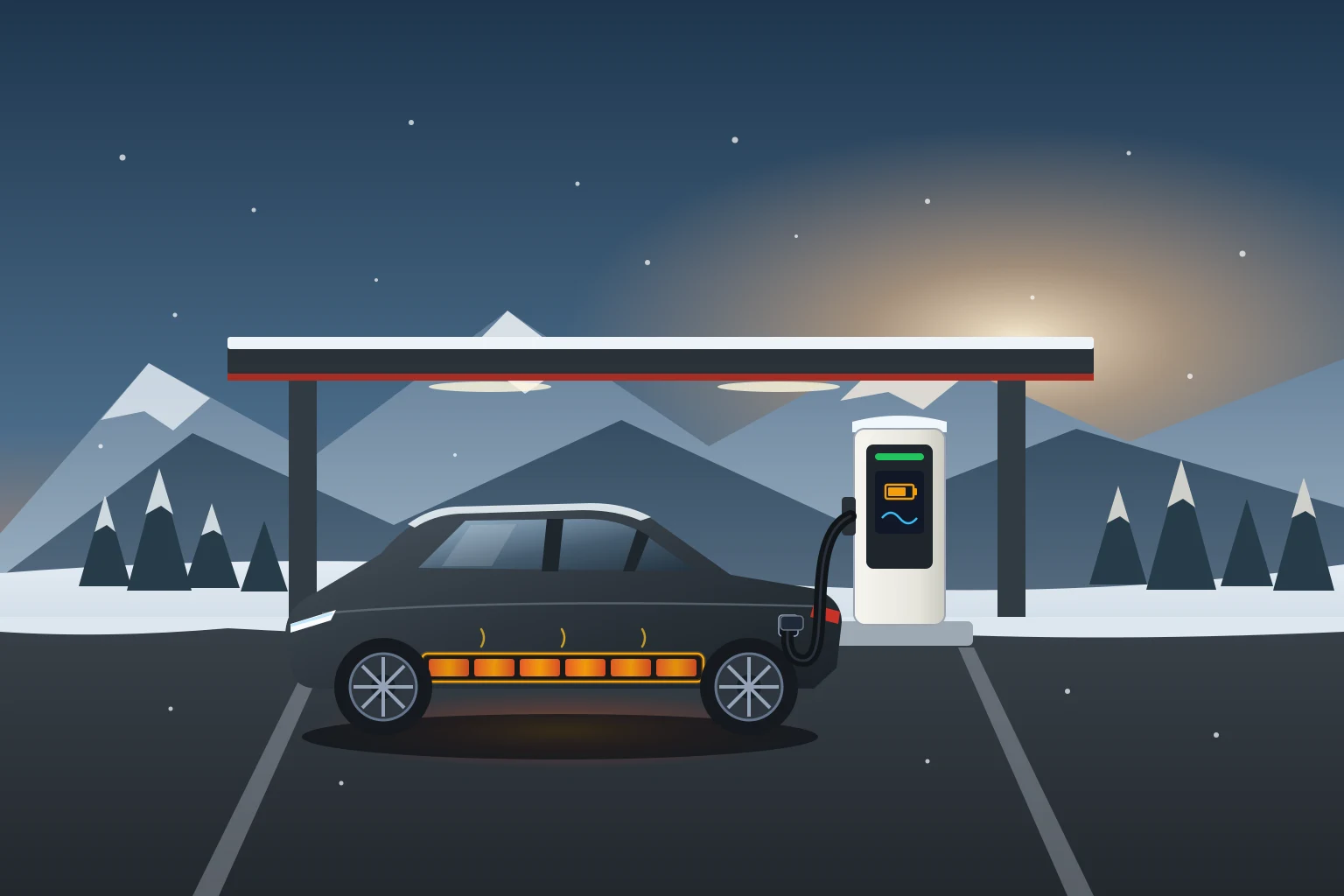
EV battery preconditioning actively warms or cools the traction battery pack into its optimal 15°C to 35°C operating window before charging so cells accept higher DC fast-charging power safely. Turn it on when temperatures drop below 10°C—ideally 20 to 30 minutes before reaching a highway fast charger—and precondition while plugged in before winter departures to preserve driving range.
Cold highway trips expose a common misunderstanding: warming the passenger cabin is not the same process as conditioning the high-voltage battery pack. Relying only on an unintegrated smartphone map on a freezing road trip often leaves the battery cold-soaked at arrival, turning a routine highway stop into a slow, throttled session.
Should You Precondition an EV Battery Before DC Fast Charging?
Yes—preconditioning before DC fast charging is one of the most effective ways to avoid slow cold-weather charging stops. Normal driving alone does not generate enough waste heat to keep lithium-ion cells in their optimal operating range in subzero climates, so active preheating prepares the pack before you plug in.
According to a peer-reviewed review of lithium-ion battery thermal management in The Innovation via NIH/NLM PubMed Central, a battery thermal management system (BTMS) and current control keep cells within an acceptable 0°C to 40°C range, while ideal thermal safety and operational efficiency sit between 15°C and 35°C with pack temperature deviation held below 5°C. Even though driving and charging produce heat inside the pack, that heat is insufficient to keep cells inside a suitable temperature window during cold-climate travel, making dedicated preheating strategies necessary.
Modern EVs typically deliver that heat through two established hardware designs described in the same review:
- Liquid coolant heating loops: Vehicle heating components warm thermal coolant and pump it through channels surrounding the battery modules, commonly sharing the same plumbing loop used for liquid cooling.
- Positive temperature coefficient (PTC) resistance heaters: External resistive elements generate Joule heat to warm the pack or circulating coolant in freezing conditions.
Kia’s driver guidance on EV battery preconditioning emphasizes that bringing the pack into its 15°C to 35°C ideal operating window before arriving at a DC fast charger supports faster charging speeds, stronger performance, and lower thermal stress in both cold and hot weather—and notes that battery preconditioning should not be confused with simply warming the car’s interior cabin.
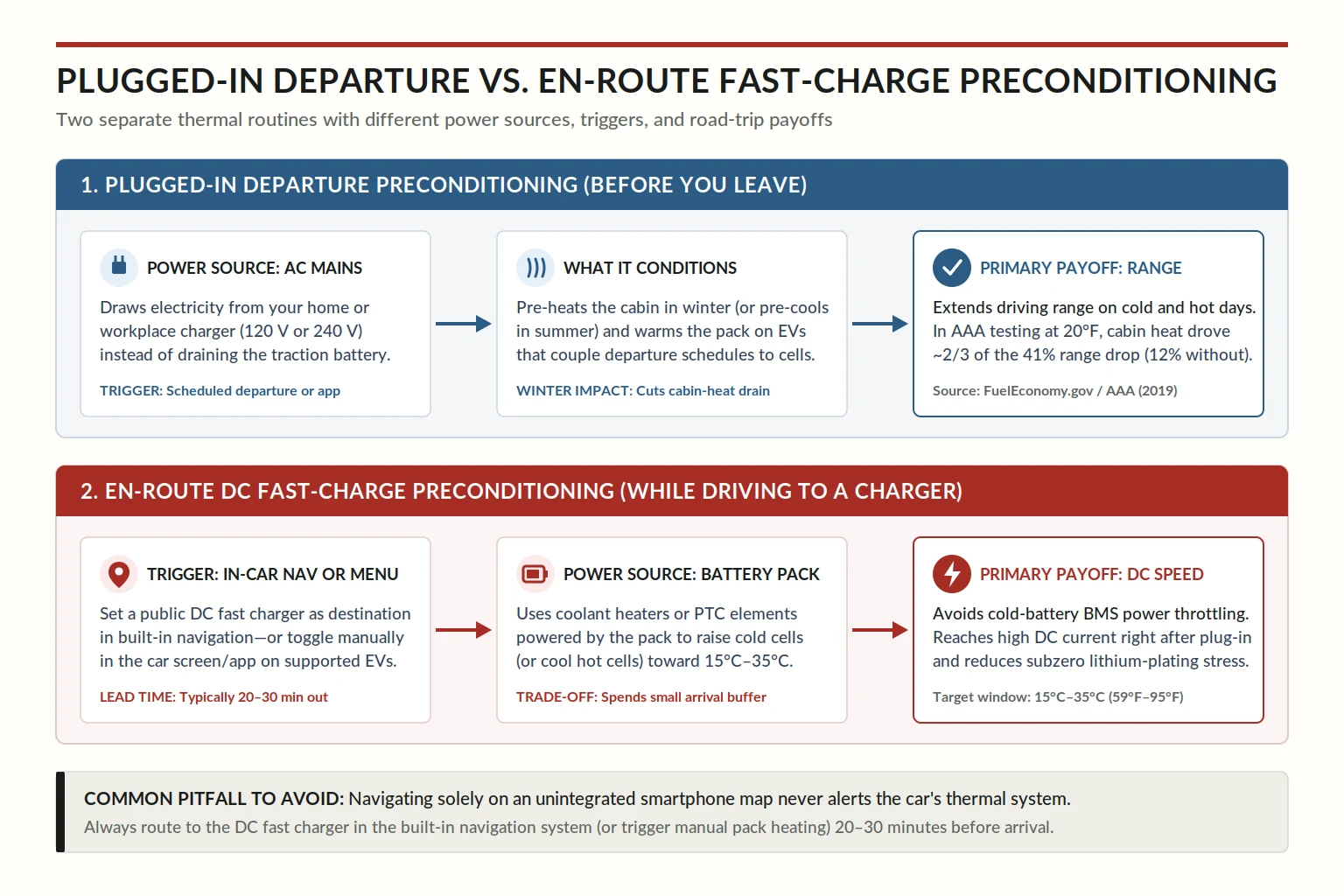
| Preconditioning Mode | Power Source | Primary Thermal Target | Typical Activation Method | Main Road-Trip Benefit |
|---|---|---|---|---|
| Plugged-in departure preconditioning | External AC power from a home or workplace Level 1 (120 V) or Level 2 (208–240 V) charger | Cabin interior (heating in winter or cooling in summer), plus battery warming on supported models | Scheduled departure timer or mobile app while the vehicle remains plugged in | Extends electric driving range by covering initial climate load from grid electricity |
| En-route DC fast-charge preconditioning | Traction battery pack while driving toward a charging station | High-voltage battery cells warmed or cooled toward the 15°C to 35°C window | Setting a public DC fast charger as destination in built-in car navigation, or toggling a manual menu or app control | Avoids cold-battery DC power throttling and reduces low-temperature cell stress on plug-in |
What Does Plugged-In Preconditioning Before Driving Actually Do in Winter?
Preconditioning an EV while it is still plugged into a charger draws power from the electrical supply instead of the traction battery, warming the cabin before departure so less stored battery energy goes toward climate control on the road. In cold weather, shifting that initial heating load onto AC mains directly protects winter driving range.
Data published by FuelEconomy.gov (U.S. DOE and EPA)—based on a 2019 AAA study—shows why cabin heating dominates winter range loss. In mixed city and highway driving at 20°F with the cabin heater running, EV fuel economy can drop roughly 39% and driving range can fall by 41%, with about two-thirds of the extra energy consumed going to cabin heating. When the cabin heater is not used at 20°F compared with 75°F, EV fuel economy is 8% lower and driving range is about 12% lower.
Why Winter Driving Drains Extra Energy Beyond the Cabin Heater
Even after you preheat while plugged in, four cold-weather factors noted by FuelEconomy.gov still affect electric car range in winter:
- Lower battery performance and weaker regenerative braking: Cold weather decreases battery performance and limits how effectively the regenerative braking system captures energy during deceleration.
- Denser cold air: Cold air is denser than warm air, increasing aerodynamic drag at highway speeds.
- Lower tire pressure: Tire pressure drops in colder weather, increasing rolling resistance until tires are inflated to specification.
- Electrical accessories: Heated seats, window defrosters, and heater fans all draw extra electrical power, though using seat warmers instead of the cabin heater saves energy and extends range.
Parking inside a garage raises the starting temperature of the car and cabin before you even plug in. As FuelEconomy.gov’s EV driving tips summarize, pre-heating or pre-cooling the cabin while plugged in extends electric range—and Kia notes that when an EV is plugged in during preconditioning, energy comes from the power source rather than the battery itself, leaving driving range unaffected.
Home AC Charging Power Matters for Departure Warm-Up
Residential charging equipment shapes how easily a vehicle finishes charging and preconditioning overnight. According to the U.S. Department of Energy Alternative Fuels Data Center (AFDC), AC Level 1 charging at 120 V replenishes roughly 40 miles in 8 hours for a mid-size EV, whereas most residential AC Level 2 chargers operate at up to 30 Amps delivering 7.2 kW on a dedicated 40-Amp circuit compliant with National Electric Code Article 625. Higher available AC power makes it easier to keep the battery topped up while heating the cabin on freezing mornings.
What Happens If You Plug a Cold EV Battery Into a DC Fast Charger Without Preconditioning?
Plugging a cold-soaked EV battery straight into a DC fast charger forces the vehicle’s battery management system to throttle initial charging power sharply to prevent permanent cell damage. Instead of drawing peak fast-charging current right away, the car charges slowly until the cells gradually warm up, stretching a highway stop well beyond normal expectations.
The underlying bottleneck is electrochemical rather than a fault in the charging post. As detailed in the all-temperature lithium-ion battery review hosted by NIH/NLM PubMed Central, subzero temperatures slow down lithium-ion batteries in four compounding ways:
- Sluggish ion transport and higher internal resistance: Low temperatures decrease electrolyte conductivity and ionic diffusivity, reduce the lithium-ion intercalation capacity of graphite anodes, and raise internal resistance and polarization voltage.
- Sharp jump in cathode resistance: At subzero temperatures, cathode charge-transfer resistance can increase by more than 200% compared with normal operating temperatures.
- Reduced usable capacity in cold cells: Subzero cold lowers available energy and power capacity; even modern lithium-ion phosphate (LFP) and graphite cells deliver only about 70% of room-temperature available capacity at −10°C and 60% at −20°C.
- Risk of metallic lithium plating: During high-current charging at low temperatures—especially at higher states of charge—lithium ions cannot enter the graphite anode quickly enough. Ions near the negative electrode trap electrons and deposit as metallic lithium, which can generate gas pockets, accelerate degradation, and grow into lithium dendrites capable of piercing the separator and causing an internal short circuit.
Because DC fast charging pushes high direct current directly into the pack, the vehicle limits intake current whenever cells are too cold. Kia notes that a cold battery plugged into a charger may charge slowly at first specifically to avoid damage. While the U.S. DOE AFDC reports that installed corridor DC fast chargers reach up to 500 kW and typically add about 100 to 200+ miles per 30 minutes (with charging times starting under 20 minutes on DC fast chargers versus 20 hours or more on Level 1, and many EVs on the road today capped at 200 kW), actual session times depend on battery depletion, capacity, battery type, and equipment output—and starting cold adds an immediate thermal delay on top of normal high-state-of-charge tapering. For how charging slows near the top of the pack once warm, see our breakdown of why EV charging slows down with state of charge.
At What Temperature Should You Precondition an EV Battery?
Plan to precondition your EV battery whenever ambient temperatures drop below 10°C before a DC fast-charging stop, treat preheating as essential below 0°C, and let active cooling protect the pack when high ambient heat or rapid DC charging pushes cell temperatures toward 40°C.
Lithium-ion thermal limits create clear operating bands rather than a single cutoff. Research synthesized in The Innovation via PubMed Central defines 0°C to 40°C as the acceptable operating band and 15°C to 35°C as the ideal cell body window for balancing charging efficiency, safety, and cycle life, while keeping temperature variation across the pack below 5°C. Kia likewise highlights temperatures below 10°C—alongside overnight outdoor parking and long winter trips—as the primary window when preconditioning delivers noticeable fast-charging gains.
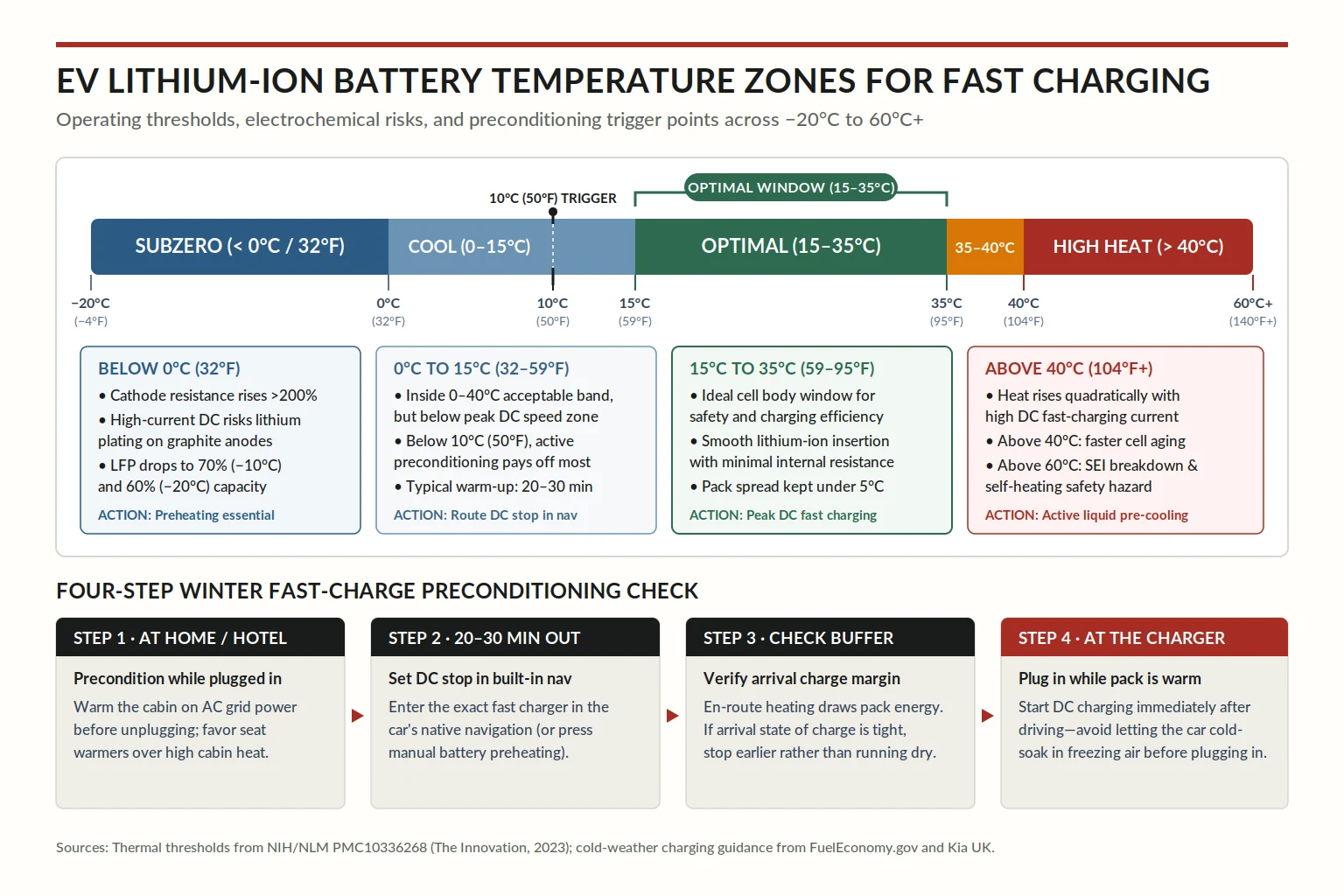
| Cell / Ambient Temperature Zone | Electrochemical and Thermal Behavior | Charging and Range Consequence | Recommended Driver Action |
|---|---|---|---|
| Subzero (below 0°C) | Cathode charge-transfer resistance rises by more than 200%; LFP/graphite cells drop to 70% capacity at −10°C and 60% at −20°C; high-current charging risks lithium plating and dendrites | Heavy initial DC power throttling, reduced regenerative braking, and lower winter driving range | Precondition while plugged in before departure and trigger en-route pack heating 20 to 30 minutes before any DC fast stop |
| Cool (0°C to 15°C; key trigger below 10°C) | Within the 0°C to 40°C acceptable band, but cells sit below optimal fast-charging kinetics—especially after overnight outdoor parking | Moderate initial DC charging slowdowns until the battery warms into its ideal range | Set the DC fast charger in built-in navigation whenever temperatures dip below 10°C |
| Optimal window (15°C to 35°C) | Smooth lithium-ion insertion and extraction with low internal resistance and pack spread ideally held under 5°C | Peak charging efficiency, rapid DC current acceptance, and lowest thermal aging stress | Standard charging routine; pre-heating is generally unnecessary |
| Elevated heat (around 40°C) | Battery heat generation rises quadratically with charging current; elevated temperatures around 40°C accelerate aging and capacity retention loss | Battery thermal management activates active cooling and may trim power if heat cannot dissipate | Route via built-in navigation on hot highway days so the BTMS can pre-cool the pack before DC fast charging |
| Extreme heat (above 60°C) | High temperatures above 60°C trigger solid-electrolyte interphase (SEI) film decomposition and self-heating hazards | Severe cycle-life reduction and safety protection cutoffs | Rely on the vehicle’s cooling system, park in shade when possible, and pre-cool the cabin while plugged in |
Why Preconditioning Also Matters in Summer Heat
Preconditioning is not exclusively a winter feature. As FuelEconomy.gov’s hot-weather guidance explains, running air conditioning under very hot conditions can cut a conventional car’s fuel economy by more than 25% on short trips, and the percentage impact on hybrids, plug-in hybrids, and EVs can be even larger. Pre-cooling the cabin while plugged into a charger, parking in the shade or using a sunshade, and choosing a warmer air-conditioning setting all reduce battery drain. At the pack level, because battery heat generation scales quadratically with charging current, cooling hot cells before a high-power DC stop helps keep cell temperatures below the 40°C threshold where aging accelerates.
Does Battery Preconditioning Improve Driving Range or Cut Charging Time?
Plugged-in preconditioning improves driving range by drawing thermal energy from the wall, whereas en-route DC fast-charge preconditioning trades a modest slice of battery energy during the drive for substantially shorter fast-charging stops. Knowing which direction the energy flows prevents range anxiety when pulling into a highway station with low charge.
How Much Energy and Time Are Actually Traded?
Exact vehicle energy draw varies by battery size, heater architecture, and outside temperature, and cold-weather effects vary by vehicle model. Published battery thermal-management experiments reviewed in The Innovation via PubMed Central illustrate the scale of the trade-off:
- Time saved at the charger: In controlled cold-weather comparisons, active pulse preheating shortened charging time by 36 minutes (23.4%) while increasing charging capacity by 7.1% under identical operating conditions.
- Pack energy spent to warm from deep cold: In an experimental self-heating lithium-ion cell, warming from −30°C to 0°C in 30 seconds consumed 5.5% of battery capacity.
Kia notes that when plugged in, preconditioning draws from mains electricity rather than the battery so driving range stays unaffected, and that any small energy use is more than offset by faster, more efficient charging. Still, if your projected arrival state of charge at a remote winter charger is already tight, prioritize reaching the station safely (or stopping at an earlier charger) over spending your last margin warming the pack. Reviewing EV road trip planning alongside an EV road trip energy and charging fee estimate helps size winter stop spacing with comfortable buffers.
| Benchmark Category | Measured Figure from Authority Source | Conditions / Context | Practical Implication for Drivers |
|---|---|---|---|
| Winter EV range with cabin heat | 41% range drop; 39% fuel economy drop | AAA 2019 mixed city and highway testing at 20°F (FuelEconomy.gov) | Plan closer winter stops and warm the cabin while plugged in |
| Winter EV range without cabin heat | 12% range drop; 8% fuel economy drop | 20°F versus 75°F without cabin heater (FuelEconomy.gov) | Roughly two-thirds of cold-weather extra energy goes to cabin heating; favor seat warmers |
| LFP cell cold capacity retention | 70% at −10°C; 60% at −20°C | Available capacity relative to room temperature (The Innovation review) | Cold packs hold less usable energy until warmed |
| Active preheating charging gain | 36 minutes (23.4%) shorter charging time; 7.1% higher capacity | Pulse preheating versus unheated cold charging comparison (The Innovation review) | En-route preheating pays back time quickly at cold DC stops |
| DC fast-charging corridor benchmark | 100 to 200+ miles per 30 minutes; stations up to 500 kW | DOE AFDC equipment overview; many EVs cap at 200 kW | Achieving expected stop times requires warm cells, not just a high-power post |
How Do You Trigger EV Battery Preconditioning Through Navigation or Manual Controls?
Trigger en-route battery preconditioning by selecting a public DC fast charger as your destination in the car’s built-in navigation system at least 20 to 30 minutes before arrival, or by enabling manual battery preconditioning through the infotainment menu or connected app on vehicles that support it.
Because FuelEconomy.gov emphasizes that EVs vary significantly in how they manage energy—and tips that work on one model may not apply to another—always verify your car’s exact preconditioning indicators and thresholds in the owner’s manual before a winter highway trip.
Built-In Navigation vs. Manual Controls
Kia’s guidance outlines the two standard trigger paths used across modern EVs:
- Automatic navigation-linked preconditioning: The most common method is entering a public fast-charging station as a destination or waypoint in the vehicle’s native navigation system. Once the route points to a recognized charger, the car begins warming or cooling the pack during the drive so cells arrive near 15°C to 35°C. Navigating solely with an unintegrated phone map generally does not notify the car’s battery thermal management system that a DC fast charge is coming.
- Manual infotainment or app activation: Many newer EVs, including the Kia EV3, EV6, and EV9, let drivers switch on battery preconditioning manually from the center infotainment screen or connected mobile app (such as Kia Connect). Manual control is especially helpful when your preferred fast charger is not listed in the car’s map database or when you want to warm the battery ahead of an early-morning winter charging stop.
Five-Step Winter Highway Preconditioning Checklist
Run through these five habits on freezing road trips to protect range and cut charging waits:
- Preheat while plugged in before leaving: Use scheduled departure or remote climate control while connected to home or hotel AC power, and lean on seat warmers rather than high cabin heat once underway.
- Enter the exact DC fast charger in built-in navigation 20 to 30 minutes out: Confirm that the station is selected as a charging destination (not just a nearby street address) so automatic pack heating activates in time.
- Confirm connector and adapter compatibility before rerouting: If cold weather pushes you to an alternate highway plaza, check plug compatibility ahead of time using our CCS vs NACS connector and adapter guide.
- Watch your arrival buffer and drive smoothly: Anticipate stops and brake gently or moderately so regenerative braking recovers energy as cells warm up, and avoid running your arrival charge so low that en-route heating creates range stress.
- Plug in immediately while the pack is warm: Start your DC fast-charging session right after arriving rather than letting the vehicle sit cold-soaked in freezing air, and keep our guide to stopping an EV charging session and releasing a stuck connector handy if latches ice up in winter weather.
Explore more electric-vehicle charging and road-trip guides in Mobility, or browse every driving and travel article in the driving and mobility blog.