CCS1 adds two bottom DC pins beneath the five-pin SAE J1772 AC plug, while NACS (SAE J3400) shares two primary pins inside one five-pin connector for AC and DC charging. Because NACS adopts the ISO 15118 protocol used by CCS1, dedicated DC adapters bridge highway networks while AC J1772 adapters stay Level 1 and Level 2 only.
North American EV road travel now runs across a dual-connector transition rather than a single plug standard. Knowing how J1772, CCS1, and NACS wire power and communication prevents two avoidable trip failures: packing a hotel Level 2 AC adapter when you actually need a highway DC fast-charging adapter, or navigating low on charge to a legacy Supercharger site that lacks ISO 15118 support.
How Do J1772, CCS1, and NACS Connectors Differ Physically and Electrically?
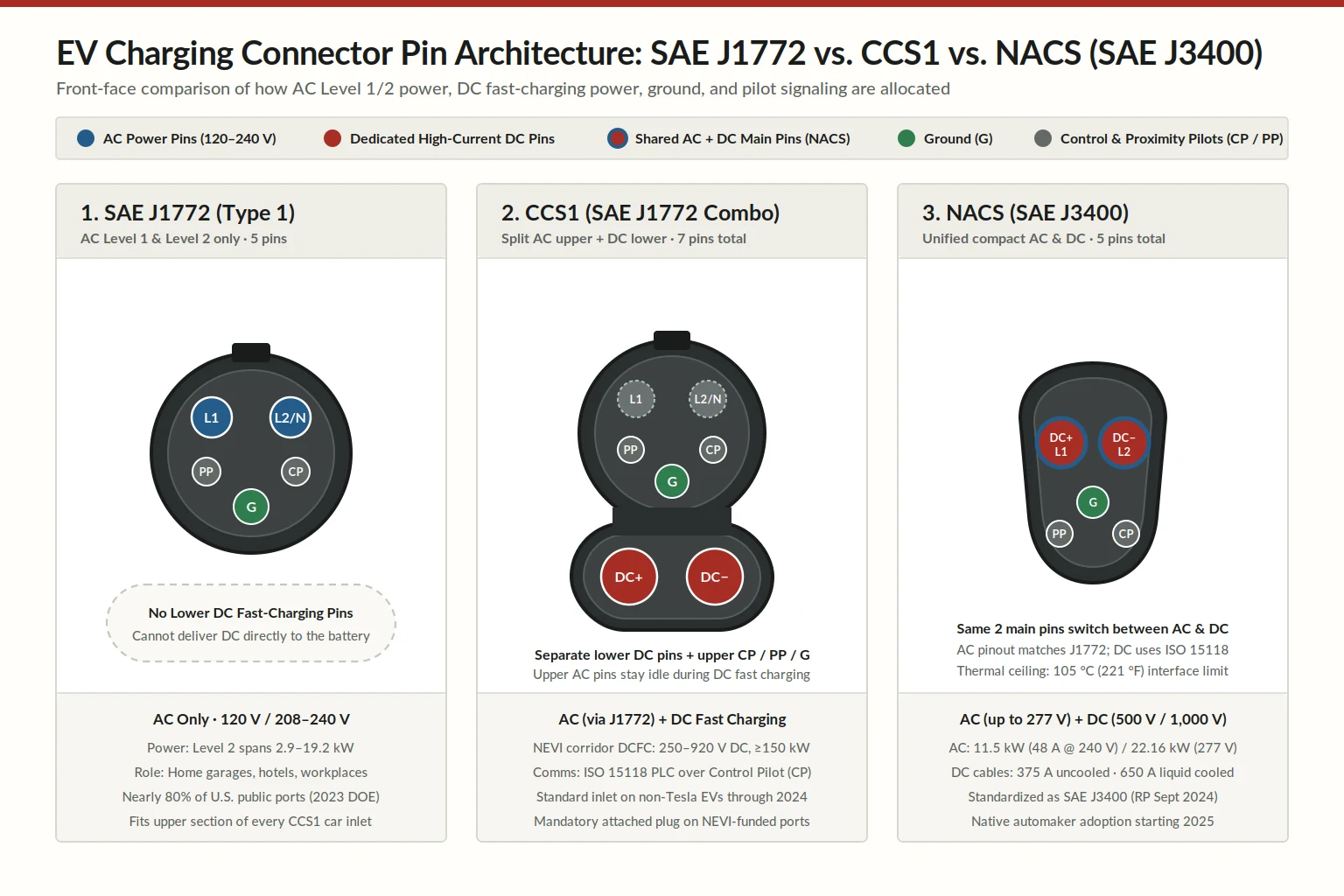
SAE J1772 is a five-pin connector dedicated exclusively to AC Level 1 and Level 2 charging, CCS1 expands that exact five-pin J1772 face with two bottom DC pins for fast charging, and NACS consolidates both AC and DC power onto two shared pins inside a smaller five-pin shell.
As outlined in the Joint Office of Energy and Transportation SAE J3400 overview, CCS1 (also called SAE J1772 Combo) uses the same five-pin layout as SAE J1772 for AC Level 1 and Level 2 charging while adding two bottom DC pins for direct-current fast charging (DCFC). That split layout lets any CCS1 vehicle inlet accept a standard round J1772 plug in its upper socket for overnight AC charging and a larger CCS1 handle spanning both upper and lower sockets at highway fast chargers.
NACS takes the opposite mechanical approach. Originally developed by Tesla and formally standardized by SAE International—with the Technical Information Report published on December 18, 2023, and the Recommended Practice redefining NACS as the North American Charging System published on September 30, 2024—the five-pin NACS plug shares its two large primary conductors for both AC and DC power transfer (North American Charging Standard technical overview):
- DC+/L1: Carries positive DC voltage during fast charging, Line 1 in North American split-phase AC mode, or the sole line conductor in single-phase AC mode.
- DC−/L2: Carries negative DC voltage during fast charging, Line 2 in split-phase AC mode, or neutral in single-phase AC mode.
- Ground (G), Control Pilot (CP), and Proximity Pilot (PP): Ground bonds the chassis, Control Pilot exchanges charging state and current data under IEC 61851 with power-line communication superimposed during DC charging, and Proximity Pilot monitors connector status so pressing the plug release button opens a switch that interrupts electrical flow.
Communication protocol alignment is what makes cross-network DC adapters possible. Unlike the original Tesla connector that relied on CAN bus communication, NACS employs the ISO 15118 protocol used by CCS1. That shared digital handshake lets CCS1 vehicles charge at compatible NACS fast chargers with a DC adapter and lets NACS vehicles charge at CCS1 stations with a DC adapter, except that Tesla vehicles built before 2021 require an ECU retrofit to communicate with CCS1 stations.
| Connector Standard | Pin Layout and Power Sharing | Voltage and Power Envelope | Digital Signaling and Protocol | Primary Road-Trip Role |
|---|---|---|---|---|
| SAE J1772 (Type 1) | Five pins dedicated to AC power, ground, and pilot signals; no lower DC pins | 120 V AC Level 1 and 208–240 V AC Level 2; Level 2 units span 2.9 to 19.2 kW | Basic pilot signaling; identical AC pin layout to NACS | Home garages, workplaces, airports, and overnight hotel parking |
| CCS1 (SAE J1772 Combo) | Upper five-pin SAE J1772 section plus two separate bottom high-current DC pins | Federally funded corridor DCFC supports 250 to 920 V DC at 150 kW or more simultaneously; installed DCFC reaches up to 500 kW | ISO 15118 power-line communication over the upper Control Pilot pin; supports Plug and Charge | Primary non-Tesla highway fast-charging port on EVs built through 2024 |
| NACS (SAE J3400) | Compact five-pin layout sharing two main pins (DC+/L1 and DC−/L2) across AC and DC modes | AC up to 11.5 kW (48 A at 240 V) or 22.16 kW (80 A at 277 V); DC configurations up to 500 V and 1,000 V | IEC 61851 Control Pilot with ISO 15118 power-line communication during DC fast charging | Unified AC/DC port on Tesla EVs and native North American EVs starting in 2025 |
Is CCS1 Becoming Obsolete as Automakers Transition to NACS?
No—existing CCS1 vehicles and corridor fast-charging stations will remain in active service for years alongside expanding NACS hardware. Every non-Tesla EV produced through 2024 carries a CCS1 port, federal corridor funding rules still mandate permanently attached CCS1 connectors, and ISO 15118 interoperability keeps both connector formats usable through adapters.
Automaker and charging-network announcements starting in 2023 accelerated native J3400 port adoption for new North American EVs beginning as early as 2025, yet the Joint Office of Energy and Transportation notes that whether CCS1 will ever be phased out completely remains unclear while every non-Tesla EV produced through 2024 retains a CCS1 port. Drivers buying or already owning a CCS1 vehicle are not locked out of highway travel.
Federal infrastructure regulation directly anchors CCS1 availability along major American interstates. Under 23 CFR Part 680, federally funded charging stations must provide at least four network-connected charging ports, and every DCFC port must be capable of charging any CCS1-compliant vehicle via at least one permanently attached CCS1 connector. Those corridor sites must also maintain an average annual uptime greater than 97%, deliver at least 150 kW continuously and simultaneously per port across 250 V to 920 V DC, and support ISO 15118-3 conformance alongside ISO 15118-2 and ISO 15118-20 hardware capability.
Rather than replacing CCS1 overnight, federal policy enables side-by-side deployment. Requirements published by the Federal Highway Administration (FHWA) in May 2023 allow J3400/NACS connectors or permanently attached adapters to be installed on federally funded DC fast chargers as long as a compliant CCS1 connector is also present. As a result, modern highway plazas increasingly pair both cable types on the same stall or sit beside retrofitted NACS networks—giving CCS1 drivers native corridor charging plus adapter access to compatible NACS stations.
Does CCS1 or NACS Charge Faster on the Highway?
Neither plug shape automatically charges faster on its own: real-world highway charging speed is capped by the lower limit of the vehicle’s battery architecture and state of charge, the charging station’s power cabinet, and cable thermal limits rather than whether the handle is CCS1 or NACS.
According to the U.S. Department of Energy Alternative Fuels Data Center, public DC fast-charging stations along highway corridors already reach power outputs up to 500 kW, and charging duration depends on how depleted the battery is, total battery capacity, battery type, internal vehicle charger capacity, and the station’s electrical service and power output. Even when pulling up to an ultra-fast dispenser, many EVs on the road today are not capable of charging at rates higher than 200 kW. FuelEconomy.gov notes that a fast charge to 80% capacity can take 30 minutes, compared with 3 to 12 hours to fully recharge a battery pack on AC power. For a deeper look at how battery management slows power draw past 80%, review our guide to why EV charging slows down with state of charge.
Both standards support high-voltage fast charging when matched to capable vehicles and cabinets:
- Voltage platform matching: Federally funded CCS1 corridor chargers must span 250 V to 920 V DC, while NACS defines two DC configurations—up to 500 V and up to 1,000 V—with the 1,000 V specification backward compatible with 500 V vehicles. On complete V4 Supercharger cabinets deployed starting in September 2025, 400 V vehicles top out at 250 kW while 800 V vehicles can draw up to 500 kW.
- Thermal and cable cooling limits: NACS does not impose a fixed current ceiling as long as the connector interface stays at or below 105 °C (221 °F), and Tesla has reported continuous currents up to 900 amperes. Commercial NACS charging cables, however, are specified up to 375 A uncooled and 650 A when liquid cooled, so cable design and thermal management govern sustained high-amperage sessions just as they do on high-power CCS1 cords.
How Do Supercharger Generations Differ for Non-Tesla and Adapter Charging?
Non-Tesla EVs using an automaker-approved NACS to CCS1 DC adapter cannot charge at every Tesla Supercharger equally: partner access targets retrofitted V3 and V4 sites running ISO 15118 electronics, whereas legacy V1 and V2 sites use older paired cabinets and Magic Dock built-in adapters remain limited to a small subset of stations.
Understanding the generation gap behind the post avoids wasted detours on interstate legs. As documented in the Supercharger hardware generation history, Tesla built four distinct DC fast-charging generations with major differences in power sharing, cable reach, voltage ceiling, and non-Tesla compatibility:
| Supercharger Generation | Power Cabinet and Peak Output | Cable Design and Voltage Range | Non-Tesla and CCS1 Adapter Compatibility |
|---|---|---|---|
| V1 and V2 (Legacy) | Single four-module cabinet shared between two paired charge posts | Shorter cables designed for rear-left Tesla charge ports; pre-date ISO 15118 retrofits | Not part of partner CCS1 adapter rollout; filter these stations out when driving a CCS1 EV |
| V3 (Introduced 2019) | Up to 250 kW per post; up to four posts share a 350 kW cabinet linked across up to three cabinets via a DC bus | Thinner liquid-cooled cables; shorter reach can require careful stall alignment for non-Tesla ports | Majority of V3 stalls retrofitted with dual CAN bus and ISO 15118 electronics for partner DC adapters; fewer than 100 V3 sites include Magic Dock as of September 2025 |
| V4 Dispenser on V3 Cabinet (Rolled Out 2023) | Up to 325 kW as of January 2025 when paired with existing backend cabinets | Longer cables built to reach charge ports on vehicles from other automakers; post rated up to 1,000 V and 1,000 A with card reader hardware | Supports partner NACS to CCS1 DC adapters and native NACS EVs; fewer than 80 V4 sites had activated Magic Dock adapters as of September 2025 |
| Complete V4 Cabinet (First Deployed September 2025) | 1 MW or 1.2 MW cabinet shared across 8 stalls without inter-cabinet DC bus | Supports 400 V systems up to 250 kW and 800 V systems up to 500 kW with longer V4 dispenser cables | Full high-voltage support for native J3400 and compatible partner EVs; select deployments only |
When Tesla opened more than 15,000 Supercharger stalls to Ford EVs on February 29, 2024, technicians had retrofitted stalls with updated electronics capable of speaking both legacy CAN bus and ISO 15118 so approved CCS1 vehicles could authenticate and charge across most V3 and V4 locations. Magic Dock stations work differently: an attached NACS to CCS1 adapter sits locked inside the pedestal so any CCS1 driver—even without a personal DC adapter—can unlock the adapter with the cable via the station’s app workflow. Because fewer than 100 V3 sites and fewer than 80 V4 sites had active Magic Dock hardware as of September 2025, drivers without an automaker-approved DC adapter should not assume an arbitrary Supercharger along an interstate has a built-in CCS1 dock.
Why Won’t a J1772 AC Adapter Work at a DC Fast Charger?
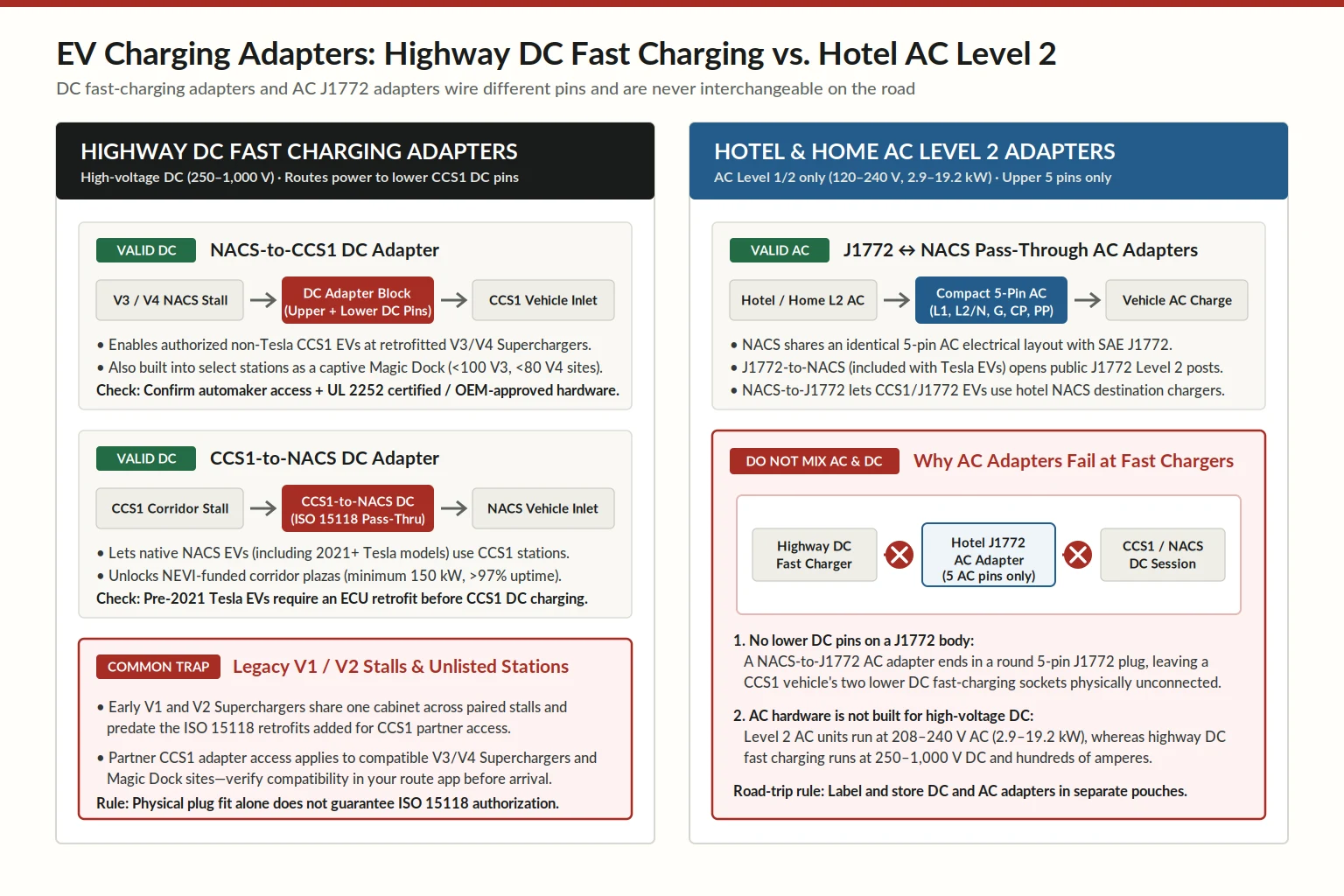
A hotel Level 2 J1772 to NACS or NACS to J1772 adapter only connects the five AC and signaling pins rated for 120 V to 240 V AC charging and physically omits the two bottom high-current DC pins required for CCS1 fast charging. Attempting to substitute a compact AC adapter at a highway DC fast charger cannot complete a DC session and mixes completely different electrical hardware classes.
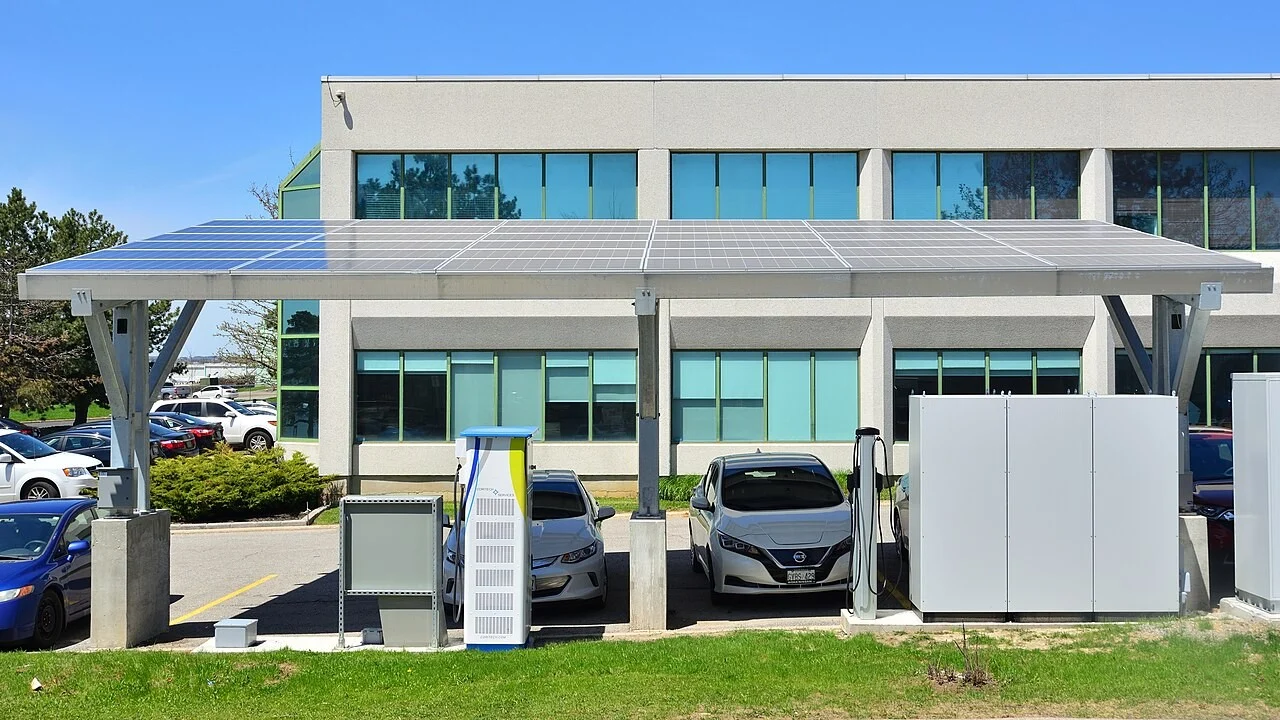
Public charging infrastructure divides cleanly by dwell time. As the U.S. DOE AFDC public charging guide explains, Level 1 and Level 2 AC chargers belong where cars park for hours—hotels, airports, workplaces, and shopping centers—whereas DC fast charging serves highway corridors and urban hubs. As of 2023, nearly 80% of public EV charging ports in the United States were Level 2 AC units (operating on 208 V commercial or 240 V residential service across 2.9 to 19.2 kW, with typical home units running up to 30 Amps at 7.2 kW on a 40-Amp circuit per National Electric Code Article 625), while more than 20% were DC fast chargers.
Because NACS keeps an AC pin layout identical to SAE J1772, simple five-pin pass-through adapters easily bridge Level 1 and Level 2 equipment in either direction—such as the J1772 adapter supplied with every Tesla vehicle for non-Tesla Level 2 posts, or a NACS to J1772 adapter letting a CCS1 car charge overnight on a hotel NACS wall charger (where NACS typically delivers up to 11.5 kW at 48 A and 240 V residential power, or up to 22.16 kW at 80 A and 277 V from commercial 480 V three-phase power).
Highway DC fast charging operates on a completely different circuit path:
- Missing lower DC power contacts: On a CCS1 vehicle inlet, high-voltage DC bypasses the onboard AC charger entirely and enters through the two large bottom DC pins. A compact NACS to J1772 AC adapter terminates in a five-pin round J1772 nose with no lower DC sockets, leaving the car’s DC bus physically disconnected.
- Incompatible voltage, current, and certification class: Highway DC fast chargers push 250 V to 1,000 V DC at hundreds of amperes directly into the traction battery. Joint Office safety guidelines treat connectors/cables under UL 2251 and high-power J3400-CCS adapters under UL 2252, which verifies mechanical latching and thermal safety far beyond lightweight AC pass-through shells.
How Should Road-Trip Drivers Pack Adapters and Screen Charging Stops?
Pack at most two clearly labeled adapters matched to your car’s inlet—one high-voltage DC adapter for highway corridors and one compact AC adapter for overnight hotel Level 2 charging—and verify automaker network eligibility before routing to any NACS Supercharger.
Match Your Adapter Kit to Your Vehicle Charge Port
Use the matrix below to confirm which physical adapters match your vehicle’s port and communication hardware before leaving home:
| Vehicle Charge Port | Highway DC Fast Charging Adapter Needed | Hotel / Overnight AC Level 2 Adapter Needed | Critical Compatibility Check |
|---|---|---|---|
| CCS1 Vehicle (Most Non-Tesla EVs Through 2024) | NACS to CCS1 DC adapter (automaker-approved / UL 2252 certified) for compatible V3/V4 Superchargers; none needed at CCS1 plazas or Magic Dock stalls | NACS to J1772 AC adapter only if your hotel or cabin offers NACS Level 2 destination chargers; none needed at standard J1772 posts | Confirm your automaker has active Supercharger network access and filter out legacy V1/V2 sites |
| Native NACS / SAE J3400 Vehicle (2021+ Tesla and 2025+ Native NACS EVs) | CCS1 to NACS DC adapter to unlock NEVI-funded and third-party CCS1 corridor stations | J1772 to NACS AC adapter (included with Tesla EVs) to access nearly 80% of U.S. public Level 2 ports | Store the bulky DC adapter separately from the pocket-sized J1772 AC adapter so you grab the right piece in rain or low light |
| Tesla Vehicles Built Before 2021 (Legacy CAN Bus) | CCS1 to NACS DC adapter works only after an ECU retrofit enabling ISO 15118 communication | J1772 to NACS AC adapter works natively on Level 1 and Level 2 AC stations | Check the vehicle’s CCS adapter support status in the car’s software screen before relying on CCS1 highway stops |
Five-Point Pre-Departure Charging Stop Checklist
Run these five quick checks when building your itinerary alongside our complete EV road trip planning guide:
- Label and separate your AC and DC adapters: Keep your heavy DC fast-charging adapter and your smaller J1772/NACS AC adapter in distinct, clearly marked pouches in the trunk or sub-trunk so you do not grab an AC adapter by mistake at a highway fast charger.
- Confirm automaker authorization and UL 2252 hardware: For CCS1 EVs visiting NACS fast chargers, verify that your vehicle brand has active partner access and carry an automaker-approved or UL 2252-certified DC adapter rather than an unrated generic block.
- Screen Supercharger generations in your route app: Set your vehicle profile and adapter filter inside your route planner so legacy V1/V2 stations are excluded automatically, leaving only compatible V3/V4 NACS-partner plazas, Magic Dock locations, and CCS1 corridor sites.
- Verify payment and stall release steps in advance: Confirm whether each planned corridor network requires an app, Plug and Charge enrollment, or a walk-up bank card using our guide to EV charging without an app, and review how to stop an EV charging session and release a stuck connector before dealing with an adapter latch in cold or wet weather.
- Pair highway DC stops with overnight Level 2 charging: Rely on corridor DC fast chargers—including federally funded NEVI plazas designed for 150 kW simultaneous delivery and greater than 97% uptime—for 30-minute legs to 80%, and save Level 2 J1772 or NACS destination chargers for overnight hotel stays.
Explore more electric-vehicle and charging guides in Mobility, or browse every driving and travel article in the driving and mobility blog.